


Views: 0 Author: Site Editor Publish Time: 2026-10-04 Origin: Site


Want cookware that looks like premium stone? The secret goes far beyond the raw material. It relies entirely on the exact spray application process. Poor spraying causes peeling, uneven textures, and premature wear. Ultimately, these defects waste critical manufacturing time and eat into profit margins.
Factory floors cannot afford guesswork. In this technical breakdown, you will discover the precise parameters, equipment choices, and quality control steps needed to master this application from the raw aluminum substrate to the final high-temperature bake.
Atomization pressure and fluid flow rate are the two most critical parameters for controlling the size, shape, and distribution of textured dots.
A high-quality application requires precise environmental controls, including strict management of paint viscosity and spray booth temperature.
Choosing the correct spray gun hardware, specifically HVLP systems with larger nozzle sizes, directly impacts the creation of a flawless finish.
Proper flash-off times and multi-stage curing temperatures must align with your spray parameters to ensure long-lasting substrate adhesion.
Routine quality control, including measuring dry film thickness and conducting cross-hatch testing, prevents common manufacturing defects like sagging and delamination.
A sprinkled non stick coating is a specialized multi-layer system utilized primarily in the cookware and bakeware manufacturing industries. Unlike traditional solid-color finishes that aim for a perfectly flat mirror-like leveling, this system features a topcoat or mid-coat containing contrasting colored droplets. When applied correctly on the production line, these droplets remain distinct rather than blending into the wet base. This creates a speckled, stone-like, or granite appearance on the surface of the pan.
The implementation of this finish goes far beyond mere visual appeal. Specifically, this application technique creates a robust surface profile that offers distinct functional advantages. The textured nature of the surface helps to mask minor surface scratches and daily wear, which are otherwise highly visible on smooth, solid-color pans. Furthermore, the raised peaks of the speckled dots often take the brunt of utensil friction. This structural design protects the lower valleys of the base coating, thereby enhancing the overall abrasion resistance and extending the usable life of the cookware.
Achieving the perfect speckled finish is a complex engineering challenge that relies heavily on fluid dynamics. The physical transformation of a liquid coating into specific, controlled droplets requires exact calibration of application machinery.
Recent market intelligence shows a definitive shift in the global cookware sector. Consumer demand for stone-derived and granite-style finishes is growing at an unprecedented rate. Shoppers want kitchenware that marries eco-friendly, PFOA-free aesthetics with heavy-duty performance. Consequently, manufacturers are rapidly upgrading their automated spray lines to accommodate these complex textures. However, the transition requires more than just purchasing new paint formulations. It demands a fundamental rethinking of fluid dynamics, droplet control, and thermal management on the production floor to remain competitive.
When liquid paint is forced through a spray gun nozzle and meets pressurized air, it undergoes atomization. The liquid stream breaks apart into thousands of tiny droplets. In a standard smooth application, the goal is for these droplets to hit the substrate, flow together, and level out into a perfectly uniform film. In contrast, the sprinkled effect requires the exact opposite behavior.
The manufacturing goal here is intentional, controlled droplet formation. The droplets must hit the surface and retain their distinct spherical or oval shapes without completely leveling into the wet base coat. If the droplets are too small, they blend into a muddy, undefined haze. If they are too large, they create heavy, uneven lumps that compromise the non-stick properties of the pan.
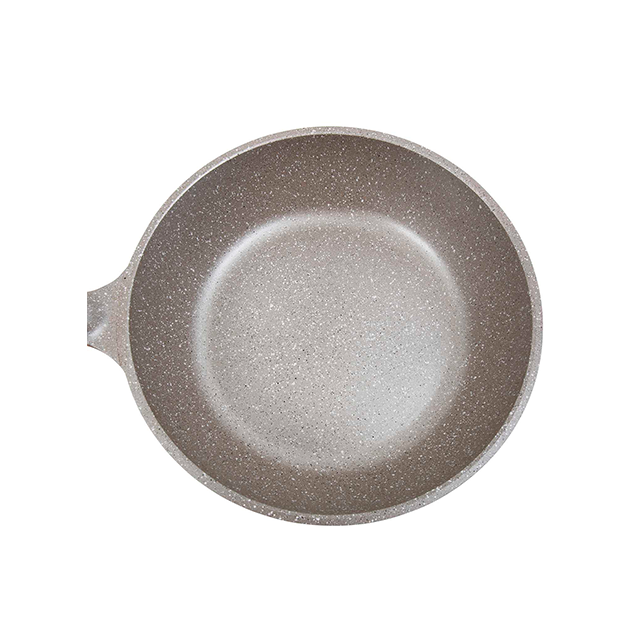
Mastering the application process requires precise control over four primary variables. On the active production line, veteran engineers understand that adjusting one parameter often requires the recalibration of the others to maintain the delicate balance of fluid dynamics.
Atomization air pressure is the primary driver of droplet size. By listening to the subtle hiss of the air cap, operators can gauge how violently the liquid stream is being broken apart.
Lower Pressure: Reducing the air pressure prevents the paint from atomizing too finely. This results in larger, heavier, and more distinct sprinkled dots, which are ideal for a bold, rugged granite look.
Higher Pressure: Increasing the air pressure shreds the liquid into smaller particles, creating a finer, mist-like speckle.
Finding the Sweet Spot: Engineers must test specific formulations on scrap panels to find the ideal pressure setting. Typically, sprinkled effects require significantly lower atomization pressure, often between 15 to 30 PSI, compared to standard smooth topcoats.
The fluid flow rate determines the volume of paint leaving the nozzle per minute. Consequently, this parameter directly affects the density and concentration of the sprinkles on the cookware surface.
A high flow rate will deposit more dots, but if it exceeds the flash-off capacity of the environment, the dots will merge into continuous streaks or cause running paint on the vertical walls of a pan. In practice, the fluid flow must be mathematically balanced with the speed of the automated spray line or robotic arm. Under-application leaves sparse, unattractive speckles, while over-application wastes expensive coating material and risks structural failure during the baking process.
The physical positioning of the spray equipment is just as critical as the internal pressure settings inside the booth.
Distance: The standard standoff distance for this application is typically 6 to 10 inches from the substrate. If the gun is too far, the solvents evaporate in the air, causing dry spray. This is a defect where the dots hit the pan as dry, powdery lumps that fail to adhere. Conversely, if the gun is too close, the droplets hit the surface with too much velocity, splattering and destroying the circular dot shape.
Angle: The spray gun must be maintained at a strict perpendicular angle of exactly 90 degrees to the cookware surface. Any deviation from this angle causes the droplets to hit the pan at a slant, resulting in elongated, teardrop-shaped streaks rather than perfectly round speckles.
Even with perfect machine settings, environmental variables can drastically alter the behavior of the liquid coating. To apply a durable decorative non stick coating, ambient control is absolutely non-negotiable.
Viscosity refers to the thickness or internal flow resistance of the liquid coating. In textured applications, viscosity matters just as much as atomization pressure. If the paint is too thin, the droplets will flatten and spread too far upon impact. If it is too thick, the spray gun will struggle to push the fluid through the nozzle, leading to inconsistent sputtering.
Furthermore, viscosity is highly temperature-dependent. As ambient temperatures rise throughout the factory shift, the coating naturally becomes thinner. Quality control technicians must continuously monitor the fluid using viscosity tools, such as a Zahn cup, and adjust parameters or add controlled amounts of thinner to maintain absolute consistency.
The ambient conditions inside the spray booth directly govern the flash-off process, which is the rate at which solvents evaporate from the wet film.
If the booth is too hot, the droplets will dry before they can properly bond to the wet base coat. If it is too cold, the solvents remain trapped, leading to sagging. High relative humidity is another major risk factor. Excessive moisture in the air can cause blushing, which is a milky, cloudy finish, or severely compromise the inter-coat adhesion between the sprinkle layer and the base coat. Therefore, climate-controlled booths are an industry standard for premium cookware manufacturing.
Achieving the precise droplet formation required for a textured cookware coating relies heavily on the physical hardware used on the production line. Standard equipment is rarely sufficient for specialized textured finishes.
In industrial manufacturing, the choice of spray gun dictates the transfer efficiency and the behavior of the atomized particles. Conventional air spray guns operate at high air pressures. While excellent for flat finishes, their high velocity tends to shatter the coating particles into a fine mist, completely destroying the distinct droplet structure needed for a stone look.
In contrast, High Volume Low Pressure systems are the industry standard for this application. These guns utilize a higher volume of air at a significantly lower pressure, typically around 10 PSI at the air cap. This lower velocity results in a softer spray pattern. The coating fluid is sheared just enough to form distinct droplets rather than a microscopic fog, drastically improving transfer efficiency and reducing material waste.
Sprinkled coatings often contain heavier solid particles, mica flakes, or heavy pigments to create the stone effect. Using a standard, narrow fluid nozzle, such as a 1.0mm size, will result in frequent clogs and inconsistent fluid delivery. To combat this, engineers must select larger nozzle and needle sets. For high-performance systems, selecting a 1.5mm to 2.2mm nozzle is specifically designed to pass thicker particles without shearing them, ensuring the decorative flakes land intact on the aluminum substrate.
Because the particles used to create the speckled effect are heavier than the surrounding resins, they are prone to rapid settling. If the coating sits idle in the pressure pot, the heavy pigments will sink. This results in the first batch of pans receiving an extremely heavy concentration of dots, while later batches receive almost none. Continuous, low-speed pneumatic fluid agitation within the pressure pot is mandatory to keep the particles evenly suspended.
The spraying process only applies the liquid. It is the curing process that dictates the final physical properties of the cookware. A flawless spray job can be entirely ruined by improper thermal management.
Before the coated cookware enters the high-temperature curing oven, it must undergo a flash-off period at ambient or slightly elevated temperatures, approximately 40°C to 60°C. This allows the highly volatile solvents to evaporate slowly. If a pan is rushed into a hot oven too quickly, the surface of the coating will skin over while solvents are still trapped underneath. As these trapped solvents boil and expand, they rupture through the surface, causing a defect known as solvent popping, which destroys the non-stick integrity.
Premium textured coatings typically require a strict multi-stage baking profile to cross-link properly.
Dehydration Zone: Operating between 100°C and 150°C, this stage safely removes remaining water and slower-evaporating solvents.
Melt Zone: At 280°C to 320°C, the polymer resins soften and flow, allowing the sprinkled droplets to settle slightly into the base layer without losing their distinct shape.
Cross-Linking Zone: Reaching extreme temperatures of 380°C to 420°C, the polymers, such as PTFE, melt, flow, and cross-link into a solid, impermeable matrix.
Proper thermal curing ensures that the raised sprinkled texture physically and chemically locks into the underlying base coat. If the base coat is over-baked before the sprinkle application, the top layer will have nothing to grip. This results in catastrophic peeling and flaking when a consumer scrapes a spatula across the pan.
Objective, standardized testing is required to ensure that the spray parameters are producing a viable commercial product.
The first line of defense is visual comparison against a master sample. Quality control personnel verify that the dot density, dot size, and color contrast match the exact specifications of the brand under standardized lighting. This ensures aesthetic uniformity across thousands of units.
Measuring the thickness of a textured surface is inherently difficult due to the peaks and valleys. Technicians use magnetic or eddy-current gauges to measure the total coating thickness by taking multiple readings across a wide grid. For a premium three-layer system, the base and mid-coat might require 25 to 35 microns, while the top sprinkle layer adds an additional 10 to 15 microns. The parameters must ensure the coating is thick enough to provide durability, but not so thick that it becomes brittle and prone to thermal cracking.
To validate structural integrity, destructive testing is performed on sample batches. The cross-hatch test involves cutting a grid into the coating, applying specialized tape, and pulling it off to check for flaking. Additionally, abrasion testing machines simulate the scraping of metal utensils to validate the scratch resistance of the textured finish over time.
Even in highly controlled environments, parameter drift can cause manufacturing defects. Swift identification and correction are vital to keep the production line moving.
Visual Defect | Physical Symptom | Primary Root Cause | Corrective Action |
|---|---|---|---|
Flooding or Sagging | Dots are too large, bleeding together, or running down the sides of the pan. | Fluid flow rate is too high relative to atomization pressure. | Decrease fluid delivery at the pressure pot. Slightly increase atomization air pressure. |
Dry Spray | Texture feels excessively rough, like sandpaper; poor non-stick release. | Droplets are drying in the air before hitting the substrate. | Move the spray gun closer to maintain a 6 to 10 inch distance. Lower spray booth temperature. |
Streaking | Sprinkles appear as elongated lines rather than distinct round dots. | Incorrect spray gun geometry or excessive traverse speed. | Correct gun angle to strictly 90 degrees perpendicular to the pan. Slow down robotic arm speed. |
Solvent Popping | Microscopic blisters or pinholes on the surface of the sprinkled dots. | Solvents boiling forcibly during the curing process. | Extend ambient flash-off time before the oven. Ensure the first oven zone is not too hot. |
Delamination | The sprinkled layer flakes off easily under light scratching. | Poor inter-coat chemical bonding. | Reduce the baking time or temperature of the underlying base coat prior to sprinkle application. |
Mastering a flawless sprinkled finish requires a delicate, continuous balance of fluid dynamics, air pressure, and environmental control. While the premium aesthetic appeal of these textured finishes drives consumer sales, it is the strict adherence to precise spray parameters that guarantees a truly durable product. By choosing the proper equipment, implementing strict thermal management, and executing rigorous quality control, manufacturers can prevent costly defects and ensure long-lasting pan performance.
To upgrade your production line and achieve the highest quality stone-effect finishes, production teams should always source reliable materials. We highly recommend exploring the high-performance formulations available at FLD Coating. Visit https://www.fldcoating.com to find the exact durable coating solutions that match your specific manufacturing requirements and elevate your cookware brand.
A sprinkled coating utilizes a specialized multi-layer architecture. While standard coatings aim for a completely smooth, leveling finish, a sprinkled system features a topcoat or mid-coat applied with precise, low-pressure parameters to create distinct, contrasting droplets. This results in a highly aesthetic, stone-like appearance that excels at hiding surface scratches.
No. Just like standard flat non-stick pans, using aerosol commercial cooking sprays on a textured surface is highly discouraged. These sprays contain emulsifiers like soy lecithin, which polymerize and burn at relatively low temperatures. This creates a sticky, invisible residue that builds up in the microscopic valleys of the texture, completely ruining the non-stick properties over time. Using a small amount of liquid oil or butter is always recommended.
Streaking is almost exclusively a mechanical application issue related to spray parameters and robotics. It occurs when the spray gun is not held at a strict, perpendicular 90-degree angle to the cookware surface. It can also happen if the fluid flow rate is set too high while the robotic traverse speed is moving too fast, causing the droplets to drag across the surface rather than landing cleanly.
When applied correctly using precise spray parameters, film thickness guidelines, and proper curing temperatures, a sprinkled coating is incredibly durable. In many cases, the textured profile can actually improve mechanical resistance. The raised peaks of the droplets absorb the initial friction from spatulas and utensils, protecting the underlying valleys of the coating and thereby extending the functional lifespan of the cookware.
Measuring a textured surface requires taking multiple readings across a wide grid using a magnetic or eddy-current gauge. Because the surface consists of peaks and valleys, a single measurement will be inaccurate. Quality control technicians calculate the average dry film thickness from these multiple points to ensure the coating falls within the precise specifications required for durability.
The ideal curing temperature depends on the specific polymer resin used in the formulation. For premium PTFE-based stone effect coatings, the final cross-linking stage typically requires a peak metal temperature between 380°C and 420°C. This extreme heat ensures the sprinkled droplets melt and bond securely into the base layer, creating a unified, scratch-resistant matrix.

Which Spray Parameters Matter for Sprinkled Non Stick Coating?

How Does Double Layer Coating Improve Primer and Topcoat Bonding?

How Can Frying Pan Coating Improve Coverage Around Curved Edges?

Nano Ceramic Coating Process for Electric Iron Soleplates

How Can Three Layer Coating Handle Thermal Cycling on Stainless Steel?

How Can Rice Cooker Inner Pot Coating Improve Rice Release?

How Can Aluminum Cookware Avoid Distortion During Coating Curing?

How Should Curing Temperature Be Set for Nano Ceramic Coating?

Which Formulation Factors Affect Non Stick Coating Scratch Resistance?

How Should Air Fryer Coating Be Tested for Oil and Cleaning Resistance?

