


Views: 0 Author: Site Editor Publish Time: 2026-10-09 Origin: Site


Investing in high-quality aluminum pans only to watch them warp, wobble, or distort during the final manufacturing stages is a massive headache. It kills profit margins and frustrates cookware producers. Aluminum dominates the kitchenware industry for good reason. It offers exceptional thermal conductivity and lightweight handling. Yet, these exact metallurgical traits make the metal highly vulnerable to structural shifts under extreme heat.
The core issue invariably traces back to the curing phase. Bonding an aluminum cookware coating to a raw metal substrate requires intense, sustained heat. If you fail to meticulously manage this thermal environment, the resulting distortion will ruin entire production batches.
This comprehensive guide dives deep into the physical science behind pan warping from a frontline engineering perspective. We will explore actionable, factory-level solutions. You will learn how to select raw materials and optimize thermal curves for different chemical formulations. Ultimately, these steps ensure your end products remain perfectly flat and durable for the consumer.
Material Matters: The physical thickness, specific alloy grade, and chosen manufacturing method act as your primary defense against heat-induced distortion.
Thermal Management is Crucial: Implementing a gradual heating curve and a strictly controlled slow cooling phase prevents catastrophic thermal shock.
Coating Selection Impacts Curing: A basic formulation demands a significantly different curing profile compared to a complex multi-layer system.
Pre-Curing Stress Relief: Utilizing stress-relief annealing on raw aluminum before applying any finishes significantly diminishes the risk of structural failure.
Tooling and Fixtures: Deploying specialized physical supports and custom molds during the conveyor oven run keeps the cookware physically aligned under extreme heat.
To effectively combat manufacturing defects, factory engineers must first dissect the underlying metallurgy. Aluminum provides unparalleled heat distribution in the kitchen. However, its behavior inside an industrial oven presents unique challenges.
Every metal expands when subjected to heat. Engineers measure this metric as the Coefficient of Thermal Expansion, or CTE. Aluminum possesses a relatively high CTE compared to heavier cookware metals like stainless steel or cast iron. When an aluminum pan enters a curing oven, often reaching temperatures between 380°C and 420°C, the atomic structure of the metal vibrates intensely. This forces the material to expand outward.
The true danger lies in uneven expansion. A typical frying pan features a thicker base and thinner sidewalls. Consequently, the thin walls absorb heat and expand much faster than the dense bottom. This discrepancy creates massive mechanical shear stress at the transition points. If this internal pressure exceeds the metal yield strength at that specific temperature, the aluminum permanently deforms. You are left with a wobbling skillet.
Thermal shock ravages the metal structure when a rapid, extreme temperature change occurs. In a bustling factory setting, this often happens if a pallet of cold aluminum skillets is thrust directly into the hottest zone of a tunnel oven. It can also occur if pans are rapidly chilled immediately after exiting the heat.
During a sudden temperature spike, the surface of the aluminum violently attempts to expand while the cooler inner core resists. This internal tug-of-war is catastrophic. The resulting plastic deformation is irreversible. Once thermal shock warps the metal, no amount of mechanical pressing can restore its original perfectly flat geometry without compromising structural integrity.
Before a pan even reaches the spray booths, it undergoes rigorous physical shaping. Heavy stamping or deep drawing processes force flat sheets of raw aluminum into three-dimensional shapes at room temperature. This cold-working drastically alters the grain structure of the metal.
While this hardens the aluminum, it also traps immense kinetic energy within the molecular lattice. We call this residual stress. When the shaped pan is later subjected to the high heat of the curing oven, the metal softens. Suddenly, these trapped mechanical stresses are unleashed. The metal desperately attempts to relax back toward its original flat sheet form. This uncontrolled release is a leading culprit behind severe sidewall warping.
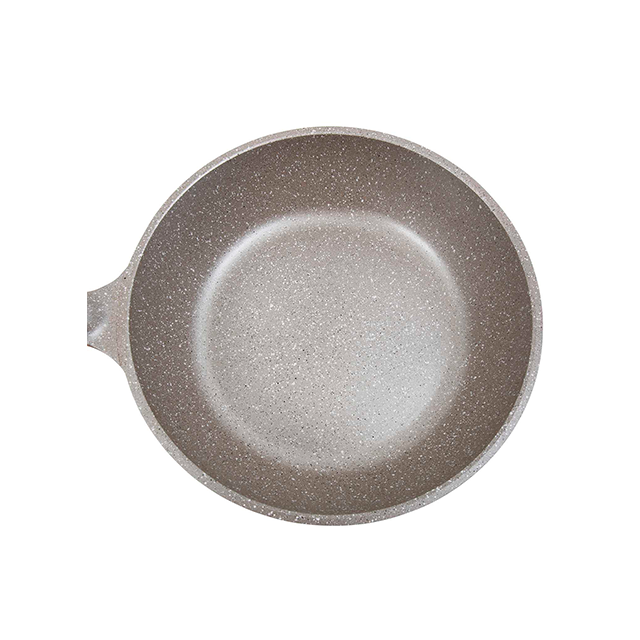
Preventing distortion does not start in the oven. It begins long before the first drop of non-stick solution is applied. Rigorous pre-treatment protocols are absolute prerequisites for producing defect-free kitchenware.
The structural survival of the pan relies heavily on base thickness. Thin metal simply lacks the mass required to resist thermal warping. For high-temperature curing environments, engineers generally mandate a minimum base thickness of 3.0mm. Premium professional lines utilize 4.0mm to 5.0mm or more.
Furthermore, the manufacturing technique dictates the inherent risk level. To help you select the right substrate, review the comparison below.
Forming Method | Residual Stress Level | Warping Risk During Curing | Recommended Base Thickness |
|---|---|---|---|
Stamped Aluminum | High | Severe | 3.0mm - 4.0mm |
Forged Aluminum | Medium | Moderate | 2.5mm - 4.0mm |
Die-Cast Aluminum | Low | Minimal | 2.0mm - 3.0mm |
Cast aluminum holds very low residual stress and resists heat excellently. Forged aluminum offers a solid balance of strength and thermal stability. In contrast, stamped aluminum carries the highest risk of distortion due to massive residual stresses. It demands the strictest thermal controls.
For forged and stamped items, stress-relief annealing acts as a critical buffer. This procedure involves heating the raw, uncoated metal in a specialized oven to a moderate temperature, typically between 340°C and 400°C. You hold it at that temperature and then allow a slow cool.
By executing this step, manufacturers safely bleed off the internal mechanical stresses caused by heavy stamping presses. Allowing the metal to stabilize in a controlled environment ensures it will not violently shift or twist when it later encounters the final high-temperature curing stage.
Proper surface prep indirectly shields against distortion. Degreasing and sandblasting create the specific surface roughness required for perfect chemical adhesion. If this step is rushed, the non-stick layer will blister or peel. This forces the factory to strip and re-coat the pan. Subjecting aluminum to multiple intense heat cycles exponentially increases cumulative thermal stress. This practice practically guarantees a warped final product.
Looking at recent manufacturing shifts, the cookware sector is rapidly moving toward smart thermal management. Energy costs are soaring globally. Meanwhile, consumer expectations for induction-ready, flawlessly flat bases are stricter than ever. Instead of relying solely on brute-force heavy-gauge aluminum to prevent warping, modern facilities invest heavily in IoT-enabled conveyor ovens that monitor real-time temperature gradients. In addition, chemical research and development now focus on low-temperature cross-linking polymers. This evolution proves that precision thermodynamics and advanced material science offer the most sustainable path to eliminating curing defects.
Not all chemical finishes behave the same way under heat. The specific formulation you select dictates the exact thermal parameters of the factory oven. This directly influences how the metal substrate will react.
A single layer non stick coating is widely utilized for mid-range cookware and small electrical kitchen appliances. Because it applies in one efficient pass, it streamlines the manufacturing timeline.
From a thermal management perspective, these single-layer systems present a significantly lower risk of metal distortion. They typically require a curing temperature around 380°C for 10 to 15 minutes. With less total thermal energy absorbed, the aluminum base is far less likely to soften and sag. The accelerated processing inherently shrinks the window of opportunity for thermal shock.
Premium professional-grade pans demand multi-layer systems to achieve maximum scratch resistance and longevity. Applying a three layer water based PTFE coating involves a delicate orchestration of a primer, a durable mid-coat, and a high-release top-coat.
This complexity severely impacts the thermodynamic journey of the pan. Multi-layer applications require intermediate flash-off stages. These are brief heating periods at lower temperatures, around 100°C to 150°C, to evaporate water and solvents between each spray. Ultimately, the fully loaded pan must endure a prolonged, highly precise high-temperature cure at 400°C to 420°C to cross-link the polymers across all three distinct layers. Keeping aluminum near its softening point for an extended duration requires extreme vigilance and advanced temperature profiling to prevent the base from buckling under its own weight.
Precision thermodynamics is the key to preserving metal geometry. You must control every phase of the oven transit.
Sudden heat is the enemy of flat metal. Industrial conveyor ovens must be meticulously zoned to facilitate a gradual heating curve, or ramp-up phase.
As raw pans rattle down the wire-mesh conveyor into the tunnel oven, they must transition through progressively hotter zones. Moving steadily from 100°C to 200°C, then 300°C, before finally hitting the peak zone ensures thermal energy permeates the substrate evenly. This calculated escalation allows the entire pan to expand at a uniform rate. It neutralizes internal shear stress.
Once the target temperature is achieved, you must maintain it with absolute precision. The resins require a specific dwell time to melt, flow together, and permanently cross-link.
If temperatures dip, the finish will under-cure and quickly degrade in the consumer kitchen. Conversely, if the heat spikes too high, the aluminum surpasses its structural threshold and sags. Advanced production lines deploy trailing thermocouples attached directly to test pans. This monitors the exact temperature of the metal itself rather than just the ambient oven air.
Counter-intuitively, a massive percentage of warping occurs after the chemical curing is complete. As the pan exits the 400°C environment, it exists in a highly expanded, malleable state.
Hitting this softened metal with a blast of cold factory air causes the exterior to contract violently while the interior remains swollen. This rapid contraction pulls the base out of shape, often bowing it outward. To combat this, step-down cooling zones utilizing ambient or slow-forced air gently bring the metal back to room temperature. This allows the atomic structure to settle evenly.
Even with flawless thermal curves, aluminum at 400°C becomes dangerously pliable. Manufacturers must employ physical strategies to support the cookware during its most vulnerable transit.
If a heavy pan is simply placed flat on a standard wire mesh belt, the uneven support inevitably causes the softened base to sag between the metal links under high heat.
To counteract gravity, professional lines utilize custom-fitted racks, jigs, or molds cast from high-carbon steel or iron. These heavy-duty fixtures cradle the exact dimensions of the cookware. By providing rigid, uniform support across the entire base, these tools physically lock the aluminum into alignment while the polymers cure.
One of the most brilliant engineering tricks in the industry is the implementation of deliberate base concavity. Knowing that metal will inevitably expand under intense heat, engineers pre-plan for this movement.
Instead of machining the raw pan to be perfectly flat, the base is stamped with a slight, calculated inward bow. This is usually 0.3 to 0.6 percent of the diameter. During the high-heat oven run, thermal expansion forces the metal to push outward. Because the base started concave, it pushes down into a neutral position. By the time it cools, the expansion has perfectly canceled out the initial bow, leaving a flawlessly flat surface.
Preventative measures are only as good as the testing that verifies them. Rigorous post-curing quality control is mandatory to ensure anti-distortion tactics have not compromised product integrity.
The ultimate physical check occurs once the pans reach ambient temperature. Inspectors place the cookware on certified, perfectly level granite surface plates.
Using precision feeler gauges sliding across the granite, technicians measure any microscopic gaps beneath the pan. Strict industry tolerances dictate that a pan must never be convex, since spinning on a glass stove is an instant failure. Any remaining concavity must be a fraction of a millimeter. Pans failing this geometry check are immediately rejected.
A dangerous shortcut in manufacturing is intentionally under-curing the coating by lowering the heat to save the metal from warping. While this keeps the pan flat, it destroys the non-stick performance.
QC labs perform destructive cross-hatch adhesion tests. They cut a grid into the surface and apply specialized tape. If the squares delaminate upon pulling, the pan was under-cured. Weighted abrasion machines further verify that the exact balance between metal stability and maximum chemical hardness was successfully achieved.
Solving thermodynamic puzzles is rarely something a factory can achieve in isolation. The chemical properties of the non-stick solution heavily dictate how the metal behaves on the line.
The specific resins, fluoropolymers, and binders used in a formulation define the exact time and heat required for polymerization. Advanced chemical suppliers invest heavily in R&D to create solutions that cross-link efficiently at slightly lower temperatures.
By utilizing a thoroughly optimized formulation, manufacturers significantly reduce the heat stress forced upon the aluminum substrate. Lowering the peak curing requirement by just 15°C can drastically plummet defect rates. This boosts overall factory profitability.
Elite suppliers do more than ship drums of liquid. They provide on-the-ground technical engineering. Are you ready to eliminate warping and upgrade your production line? Choose formulations designed for superior thermal stability and ease of application. Explore high-performance, industry-leading solutions tailored to your factory needs at FLD Coating today.
Generally, no. Once the aluminum has warped and the non-stick surface has fully cross-linked in the high-temperature oven, the structural change is permanent. Attempting to forcefully bend or press the metal back into a flat shape will cause the rigid, cured surface to crack, splinter, or delaminate from the substrate. Prevention during the manufacturing stage is the only viable solution.
It does not necessarily require a higher peak heat, but it generally demands a much more complex and prolonged thermal cycle. Multi-layer systems require intermediate flash-off heating stages to evaporate solvents between applications. This prolonged overall exposure to elevated temperatures means the aluminum base is under thermal stress for a longer duration, requiring exceptionally vigilant mechanical support and cooling processes.
While the ideal thickness depends heavily on the manufacturing method, a base thickness of at least 3.0mm to 4.0mm is generally recommended by industry experts. Thicker bases possess a higher thermal mass and greater structural rigidity, allowing them to withstand the intense thermal stress of a 400°C curing oven without buckling. Thinner pans are highly susceptible to distortion and require aggressive mechanical tooling.
Metal naturally expands when subjected to extreme heat. If an aluminum pan is engineered to be perfectly flat before it enters the curing oven, thermal expansion will force the metal outward, creating a spinner that wobbles on flat stovetops. By starting with a slightly concave, inward-bowed base, the inevitable thermal expansion pushes the metal outward just enough so that, once cooled, it settles into a perfectly flat shape.
Conveyor speed directly dictates the dwell time and the rate of heating. If the belt moves too fast, the pan undergoes rapid thermal shock as it enters the peak heat zone, drastically increasing the risk of warping. A properly calibrated, slower conveyor speed ensures a gradual ramp-up, allowing the aluminum to expand uniformly and safely.
For induction-ready cookware, maximum contact with the magnetic stove surface is critical. Industry standards typically allow a post-curing concavity of no more than 0.3 to 0.5 millimeters measured at the center of the base. Any concavity deeper than this will result in poor induction heating efficiency, while any convexity will cause the pan to spin.

How Can Aluminum Cookware Avoid Distortion During Coating Curing?

How Should Curing Temperature Be Set for Nano Ceramic Coating?

Which Formulation Factors Affect Non Stick Coating Scratch Resistance?

How Should Air Fryer Coating Be Tested for Oil and Cleaning Resistance?

How Can Hair Straightener Coating Keep Heating Plates Smooth?

How Can Water Based Fluorine-Free Coating Fit a Mass Spray Line?

How Can Three Layer Coating Stay Consistent in Continuous Production?

How Can Frying Pan Coating Balance Food Release and Wear Resistance?
Water Based Fluorine-Free Coating for Rice Cooker Inner Pots

How Non-Stick Coatings Are Manufactured Step by Step

