


Views: 0 Author: Site Editor Publish Time: 2026-10-05 Origin: Site


Ever brought home a brand-new pan, eager to cook, only to see it marred by scratches within a few short weeks? The grating sight of flaking material not only ruins the cooking experience but also raises severe concerns about product longevity, safety, and brand reputation. For manufacturers and end-users alike, premature coating failure is a costly problem.
Chemically speaking, non-stick materials excel at repelling other substances. This remarkable surface slip comes with a strict mechanical trade-off. The base polymers are inherently soft. Without chemical intervention and precise engineering, they remain highly vulnerable to the daily grind of kitchen life, from metal spatulas to abrasive scouring pads. Moving past the marketing jargon, we need to explore the exact formulation science and engineering principles behind a truly lasting cooking surface.
Fillers Act as Microscopic Armor: Hard particles such as titanium, diamond dust, and advanced ceramics function as structural pillars. They shield the softer non-stick polymers from the sharp edges of metal utensils.
Binders Dictate Lifespan: A surface's scratch resistance relies heavily on the primer formulation. If the binder cannot firmly lock the non-stick layer to the underlying metal substrate, the entire system inevitably fails.
Single-Layer Technology is Evolving: Recent innovations in polymer stratification have made single-pass applications a viable, highly cost-effective manufacturing option for specific appliances, offering excellent film thickness and heat resistance.
Curing is a Critical Variable: The precise time and temperature at which a coating is baked dictate polymer cross-linking. Even the most advanced chemical mix will fail if improperly cured.
Designing a surface capable of surviving years of commercial or residential culinary abuse requires a deep dive into failure modes. Coating degradation generally manifests through two distinct mechanical actions. The first is scratching, which is characterized by acute, sharp-point damage. Imagine a metal fork suddenly gouging the bottom of a skillet. In contrast, abrasion is the slow, cumulative wearing down of the film over time. This is typically driven by rough cleaning pads or the repetitive sliding of cooking tools.
This dynamic introduces the fundamental paradox of Polytetrafluoroethylene, commonly known as PTFE. As the backbone of most traditional non-stick surfaces, PTFE boasts one of the lowest coefficients of friction of any known solid. The exact chemical architecture that makes it so remarkably oil and water-repellent also yields exceptionally weak intermolecular forces. Pure PTFE is incredibly soft. It simply lacks the tensile strength to resist physical trauma on its own.
The core challenge for formulation chemists is striking a delicate balance between release properties and mechanical strength. Achieving this synergy requires a sophisticated composite matrix. To guarantee a reliable, durable non stick coating, engineers cannot rely on pure fluoropolymers alone. They must construct a multi-tiered defense system that absorbs and deflects mechanical stress.
Before any reinforcing agents enter the mixing vat, the base polymer itself establishes the primary thermal and chemical baseline of the pan. Different polymeric foundations offer wildly varying degrees of inherent hardness and flexibility.
High-quality non-stick systems rarely depend on a single type of fluoropolymer. Instead, formulators meticulously blend different molecular weights of PTFE, Perfluoroalkoxy alkane, and Fluorinated ethylene propylene. While PTFE delivers the ultimate slickness, the other compounds act as crucial modifiers. They melt and flow with ease during the high-heat baking process, effectively sealing microscopic voids within the PTFE structure. By tweaking the ratios of this chemical cocktail, manufacturers significantly increase the density and toughness of the cured film.
Diverging entirely from carbon-based plastics, ceramic coatings leverage sol-gel technology. This process relies on a silica-based, inorganic network. Once cured, the matrix transforms into a rigid, glass-like barrier. From a strictly mechanical perspective, these ceramic formulations boast a much higher initial pencil hardness compared to standard PTFE. However, this rigidity comes with a notable caveat. The non-stick functionality of silica-based coatings tends to degrade more rapidly under high searing heat and repeated detergent washing.
Meanwhile, silicone resins form a highly flexible matrix predominantly relegated to the bakeware sector. They provide phenomenal release for high-sugar baked goods. Yet, their molecular structure is considerably softer than both fluoropolymers and sol-gel ceramics. Lacking the necessary tensile strength to deflect sharp impacts, silicone is generally excluded from high-abrasion stovetop applications.
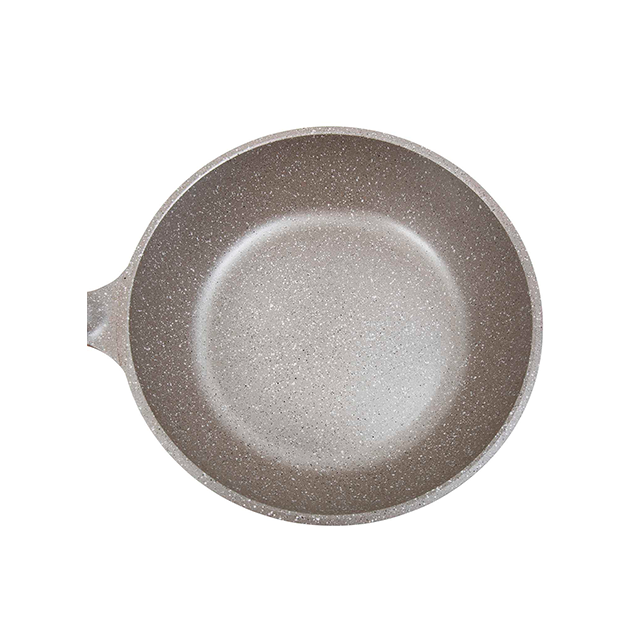
Because the foundational polymers are intrinsically soft, they demand physical reinforcement. Chemists overcome this hurdle by dispersing microscopic, ultra-hard particles directly into the liquid coating dispersion.
To visualize this mechanism, picture a layer of soft clay heavily embedded with jagged, dense rocks. When a rigid stainless steel spatula scrapes across the surface, it does not dig into the clay. Instead, it rides along the peaks of the hard rocks. These microscopic pillars bear the brunt of the mechanical load. They deflect sharp edges and shield the vulnerable non-stick polymer below.
For mid-tier to premium cookware, formulators frequently turn to mineral and ceramic powders like silicon carbide and aluminum oxide. Aluminum oxide is a remarkably brutal compound that exponentially raises the abrasion threshold of the matrix. When engineering a top-tier abrasion resistant cookware coating, manufacturers deploy even harder materials. Infusing the mid-coat with synthetic diamond dust or utilizing titanium plasma spraying creates a jagged, ultra-hard topography. The resulting system can easily survive accidental encounters with metal utensils without catastrophic failure.
Furthermore, the success of these fillers hinges heavily on particle size and spatial distribution. If the ceramic chunks are too large, they will pierce through the top layer, creating a sandpaper-like texture that aggressively traps food. Conversely, if they are too small, they fail to offer meaningful load-bearing support. Proper dispersion is vital for a smooth, resilient finish.
An exceptional scratch resistance rating becomes entirely irrelevant if the coating chips or peels away from the underlying aluminum in sheets. The true longevity of a non-stick surface is anchored by its primer layer.
Fluoropolymers are famous for being non-stick, which presents a distinct manufacturing nightmare. They refuse to stick to the metal pan. To bridge this gap, chemists utilize high-temperature engineering plastics, predominantly Polyamide-imide and Polyethersulfone. These robust resins possess incredible thermal stability and aggressive adhesive properties.
During production, the bare metal is roughly sandblasted. The viscous primer flows deep into these newly formed microscopic valleys. As it bakes, it mechanically locks the entire coating system to the substrate. Formulators must carefully calibrate adhesion to the bare metal against cohesion between the individual coating layers. Strong cohesion guarantees the slick top-coat will not shear away from the reinforced mid-coat during heavy use.
When engineering an abrasion-resistant surface, manufacturers must select an architectural framework based on the product's intended end-use. The choice generally falls between traditional stratified multi-layer systems and highly advanced single-layer technologies.
Historically, the pinnacle of scratch resistance has been achieved through 3-coat architectures. Each layer is highly specialized. The primer grips the metal, the mid-coat serves as the structural core packed with hard fillers, and the top-coat maximizes food release. This strict separation of duties creates a robust, heavy-duty surface ideal for professional restaurant environments.
In contrast, recent leaps in polymer chemistry have birthed stratifying single-layer formulations. In these systems, a single, complex liquid mixture is sprayed onto the substrate. The ingenuity happens inside the curing oven. Driven by precise differences in molecular weight and surface energy, the liquid naturally separates as it heats. The heavier binder resins sink to grip the metal, while the lightweight fluoropolymers bloom to the top.
For manufacturers producing light-to-medium duty appliances, utilizing a durable single layer kitchenware coating offers a phenomenal balance of cost-efficiency and reliable performance. Practical engineering data shows that an optimized single-layer PTFE formulation can achieve a continuous working temperature of 260 degrees Celsius, with a dry film thickness ranging from 10 to 20 microns, providing excellent substrate hiding power and adequate scratch deflection for daily household use.
To help manufacturers and engineers specify the correct formulation for their product lines, the following matrix outlines the operational differences between coating architectures.
Architecture Type | Typical Film Thickness | Pencil Hardness | Best Application Scenarios |
|---|---|---|---|
Single-Layer PTFE | 10 - 20 μm | HB - F | Rice cooker inner pots, baking sheets, electric griddles, light-duty appliances. |
2-Coat Reinforced System | 20 - 30 μm | F - 2H | Standard household frying pans, daily-use cookware, woks. |
3-Coat Premium System | 35 - 50+ μm | 3H - 9H | Commercial restaurant pans, high-end consumer cookware subjected to metal utensils. |
A broader look at the manufacturing sector reveals a distinct industry pivot regarding formulation standards. Driven by tightening global regulations surrounding legacy PFAS compounds and a highly educated consumer base, B2B buyers are actively demanding greater transparency in durability metrics and environmental safety.
We are currently witnessing a significant trend toward hybrid formulations. Manufacturers are increasingly bridging the gap between traditional fluoropolymers and eco-conscious sol-gel ceramics. Chemical engineers are striving to deliver the extreme high-heat safety of ceramics without sacrificing the long-term, frictionless release of traditional PTFE. Today, buyers no longer just test for initial non-stick release. They require quantitative, lab-verified proof of prolonged abrasion thresholds, such as Taber wear indices, before committing to a large-scale formulation purchase.
Even the most perfectly balanced chemical dispersion will fail spectacularly if the factory curing process is flawed. The transformation from a wet liquid into a highly cross-linked, solid film is governed by absolute precision in time and temperature. For instance, high-performance PTFE coatings typically require a strict curing window of 380 to 400 degrees Celsius for 10 to 15 minutes.
The baking process generally unfolds across three thermodynamic phases. Initially, the flash-off phase evaporates the water and carrier solvents. Next, the binder curing phase forces the resins to chemically cross-link, permanently anchoring the matrix to the metal. Finally, the sintering phase pushes temperatures to the extreme. Here, the fluoropolymer particles melt and fuse together, forming an impenetrable web around the hard reinforcing fillers.
Temperature control is unforgiving. Under-curing leaves the polymer chains unlinked, resulting in a soft, gummy surface that scratches immediately. Conversely, over-curing subjects the matrix to thermal degradation. The resins become brittle and lose their elasticity, leading to a pan that micro-cracks and flakes at the slightest impact.
To validate these complex chemical architectures, engineers subject finished products to a battery of brutal, standardized laboratory tests. These empirical evaluations condense years of consumer abuse into a matter of hours.
The Pencil Hardness Test evaluates the sharp-point scratch resistance of organic coatings. Technicians take drafting pencils of varying hardness, flatten the tip, and push the lead against the coated surface at a precise 45-degree angle under a strict weight load. While unreinforced PTFE might only score an HB, advanced titanium-infused formulations can confidently reach 4H to 9H.
While the pencil test measures scratching, the Taber Abraser evaluates long-term frictional wear. A coated panel is mounted on a spinning turntable, and standardized abrasive wheels grind the surface under a specific load. Durability is quantified by measuring the exact mass loss of the coating after a set number of cycles. Lower mass loss indicates superior abrasion resistance.
Considered one of the most aggressive assessments in the industry, the Tiger Paw test replicates extreme cooking trauma. A weighted, rotating mechanical head fitted with rigid metal tines scrapes a heated test pan continuously. Technicians record the precise number of cycles required to tear through the coating and expose bare metal.
Creating a reliable cooking surface is far more than just spraying a slick chemical onto a piece of shaped aluminum. It is a precise symphony of material science and mechanical engineering. The base polymers dictate the foundational release properties, while ultra-hard fillers act as the necessary physical armor. Beneath it all, high-temperature binders anchor the system, and rigorous curing ovens lock the chemical matrix into a durable solid.
For cookware manufacturers and appliance brands, selecting the right formulation directly impacts product lifespan, user satisfaction, and warranty claims. Whether you require a high-build, multi-layer system for commercial pans or a cost-effective, durable single-layer coating for electric appliances, partnering with an experienced formulation provider is critical. To explore specific technical parameters or find the exact coating architecture tailored to your production line, visit FLD Coating to review our comprehensive industrial solutions.
The gradual degradation of a non-stick pan is caused by a combination of thermal stress, chemical exposure, and mechanical friction. Every time you cook, the microscopic top layer of fluoropolymers is subjected to abrasion from spatulas and cleaning pads. Over time, this constant wear strips away the soft non-stick layer, eventually exposing the rougher, filler-heavy mid-coats underneath. Heating a pan beyond its recommended temperature also causes polymer chains to slowly break down, accelerating this thinning process.
Modern, reputable non-stick coatings are formulated without PFOA and are chemically inert. From a strict toxicity standpoint, accidentally ingesting microscopic flakes of cured PTFE from a scratched pan is generally considered harmless, as the inert material passes through the digestive system without reacting. However, a deeply scratched pan loses its primary release properties, causing food to stick and burn. Gouges can also expose the bare aluminum substrate and harbor lingering bacteria. For optimal cooking performance and hygiene, heavily scratched pans should be replaced.
It depends entirely on the intended application. For heavy-duty restaurant frying pans subjected to metal utensils and high heat, a thick 3-layer system with extensive ceramic reinforcement will offer superior long-term durability. However, modern stratifying single-layer coatings provide excellent, cost-effective scratch resistance for light-to-medium duty applications. Appliances like rice cooker inner pots and electric griddles rarely encounter sharp metal tools. In these controlled environments, an advanced single-layer system performs exceptionally well.
Currently, the absolute highest level of scratch resistance in non-stick cookware is achieved by multi-layer PTFE systems reinforced with titanium plasma spraying or synthetic diamond dust. These ultra-hard microscopic fillers act as an impenetrable barrier that protects the softer PTFE. While pure Sol-Gel ceramic coatings initially exhibit a harder surface right out of the box, empirical testing shows they tend to lose their non-stick release properties much faster than high-end, reinforced PTFE formulations under continuous daily use.
Curing temperature is the absolute deciding factor in polymer cross-linking. If the temperature is too low, the binder resins fail to adhere properly to the metal substrate, and the fluoropolymers do not melt together, resulting in a soft, easily scratched surface. If the temperature is too high, the polymers suffer thermal degradation, becoming brittle and prone to flaking. A precise, manufacturer-specified curing window is required to achieve maximum tensile strength and adhesion.
The ideal dry film thickness varies by formulation and application. For light-duty appliances using a single-layer system, 10 to 20 microns is standard and sufficient. For daily-use household cookware, a 2-coat system typically ranges from 20 to 30 microns. For professional, highly scratch-resistant surfaces, a 3-coat reinforced system should measure between 35 and 50 microns to provide adequate depth for the hard fillers to absorb mechanical impacts.

How Can Aluminum Cookware Avoid Distortion During Coating Curing?

How Should Curing Temperature Be Set for Nano Ceramic Coating?

Which Formulation Factors Affect Non Stick Coating Scratch Resistance?

How Should Air Fryer Coating Be Tested for Oil and Cleaning Resistance?

How Can Hair Straightener Coating Keep Heating Plates Smooth?

How Can Water Based Fluorine-Free Coating Fit a Mass Spray Line?

How Can Three Layer Coating Stay Consistent in Continuous Production?

How Can Frying Pan Coating Balance Food Release and Wear Resistance?
Water Based Fluorine-Free Coating for Rice Cooker Inner Pots

How Non-Stick Coatings Are Manufactured Step by Step

