


Views: 0 Author: Site Editor Publish Time: 2026-10-05 Origin: Site


Picture this. You flip a delicate crepe or slide a perfectly fried egg out of your favorite skillet. Suddenly, the food stubbornly clings to the curved rim. For many home chefs, curved edges cause non-stick finishes to peel and degrade prematurely. Why does this happen? Gravity naturally pulls liquid polymers downward during the factory application process. In this comprehensive engineering guide, we explore the exact science behind edge coverage. We will detail how proper formulation and advanced application techniques permanently fix these structural vulnerabilities.
Curved edges are highly susceptible to coating thinning and sagging. Overcoming this structural challenge requires precise viscosity control and advanced rheological formulations.
Proper surface preparation is critical. Specific grit sandblasting and alkaline degreasing help a polymer finish adhere to steep metal walls.
A multi-layer system offers superior edge protection. It utilizes a dedicated primer, a reinforced mid-coat, and a high-release top-coat.
Choosing the correct formulation depends heavily on the specific curve radius of the pan, the substrate material, and the intended culinary application.
Automated robotic spraying and rotational curing are current industry standards. They completely prevent liquid pooling at the base of curved cookware.
Achieving a uniform mirror-like finish on a completely flat surface is a standard highly predictable procedure for cookware manufacturers. However, introducing curved edges, steep sidewalls, and flared rims drastically changes manufacturing dynamics. It turns a simple spray job into a complex physics equation.
Applying liquid formulations to a sweeping curve introduces immediate challenges. Gravity and shear stress take over. On steep edges, gravity causes the wet material to flow downward long before it has the opportunity to flash-off and dry. Consequently, this creates a microscopic thinning of the protective barrier at the top rim. It also causes an unwanted thickening or pooling at the bottom radius where the sidewall meets the base. Left unmanaged by production engineers, this uneven distribution severely compromises both the thermal conductivity and the mechanical strength of the cookware.
Beyond gravity, surface tension drives coating failures on complex geometries. Liquid polymers possess a natural cohesive force. During the high-temperature drying and curing phases, the material attempts to shrink. It naturally pulls away from sharp angles and tight radii. Driven by surface energy dynamics, this behavior creates invisible micro-fissures. It can also cause a defect known as edge pull. The underlying metal substrate is left dangerously exposed or covered only by a fragile gossamer-thin layer of PTFE.
Inadequate edge coverage inevitably leads to a cascade of kitchen performance issues. The top rim frequently serves as the primary point of contact for metal spatulas, aggressive stirring spoons, and heavy glass pot lids. Thin barriers in these high-impact zones guarantee premature wear and flaking. Once this protective seal breaches, acidic food particles and moisture rapidly penetrate the substrate. Unsightly rust or galvanic corrosion follows quickly. Implementing a highly engineered frying pan non stick coating designed specifically to grip complex geometries is essential. For instance, premium single-layer systems can achieve a precise 15 to 20 microns thickness even on curves, curing at 380 to 400 degrees Celsius to lock in durability. This combats structural vulnerabilities and dramatically extends the lifespan of the pan.
Solving the physical dilemma of curved edges begins deep within the chemical laboratory. The liquid matrix must be meticulously engineered. It needs to balance effortless flowability during the initial spray application with rigid stability during the thermal curing process.
Chemical engineers manage edge coverage primarily by adjusting the rheology of the liquid, specifically its viscosity. Modern high-performance formulations utilize thixotropic agents to achieve this balance. A thixotropic fluid behaves uniquely. It maintains a lower viscosity when subjected to shear stress—like being forced through an industrial spray nozzle at high pressure. This allows it to atomize into a beautiful fine mist. The exact moment those droplets land on the curved rim of the pan, the shear stress dissipates. The viscosity rapidly spikes. This instant thickening allows the fluid to cling tenaciously to steep walls without dripping, sagging, or running.
Manufacturers incorporate advanced adhesion promoters into the chemical blend to ensure the polymer film remains firmly anchored. Polyamide-imide and specific silane coupling agents act as molecular bridges. They possess reactive functional groups that form unbreakable covalent bonds with the metal oxide layer of the pan. Simultaneously, they entangle deeply with the fluoropolymer chains. This robust chemical bonding ensures the finish resists the mechanical stress of shrinking away from the rim during baking.
Looking at recent industry developments and engineering analyses, there is a clear undeniable shift toward AI-driven fluid dynamics modeling in cookware manufacturing. Leading developers now simulate exactly how liquid polymers behave on flared rims under various thermal conditions before a single physical pan is ever sprayed. This predictive digital modeling forces chemical engineers to formulate highly thixotropic finishes that naturally resist edge-pulling right out of the spray gun. Furthermore, stricter global environmental regulations are accelerating the phase-out of legacy PFAS compounds. The industry is rapidly adopting low-VOC water-based systems. These modern eco-friendly formulations offer exceptional leveling properties. Advanced wetting agents reduce the surface tension of the liquid, allowing it to conform flawlessly to the microscopic topography of curved metal without pooling at the base.
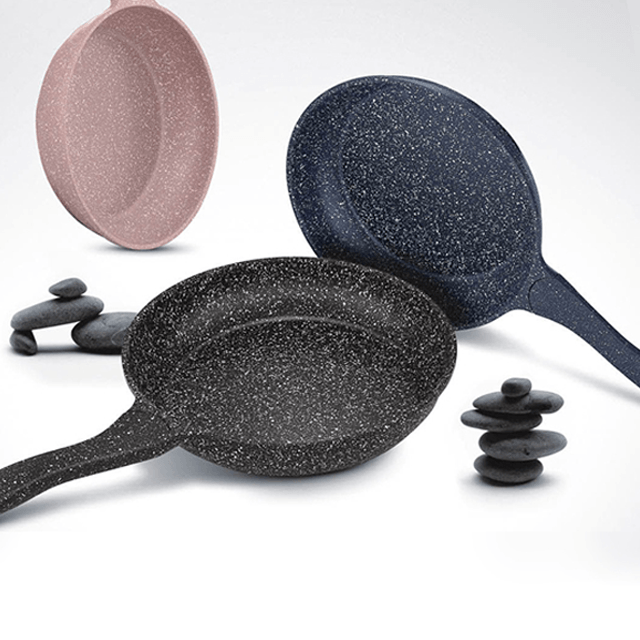
A single application is often insufficient to provide lasting edge protection for premium culinary tools featuring deep aggressive curves. Professional woks, chef sauté pans, and high-walled skillets demand more. A multi-layer system strategically separates the functional requirements of the finish into distinct highly specialized strata.
The primer acts as the absolute most critical layer for curved edges. It is intentionally formulated with a high ratio of binder resins and a much lower concentration of PTFE. Its primary job is not providing food release. Instead, it aggressively grips the microscopic peaks and valleys of the freshly sandblasted metal. The primer essentially locks onto steep angles like microscopic velcro. It establishes a corrosion-resistant foundation that prevents all subsequent layers from sliding downward. In premium setups, this primer layer is carefully applied at a thickness of 10 to 15 microns.
Sitting directly above the primer, the mid-coat serves as heavy-duty structural reinforcement. It adds the necessary dry film thickness to physically pad curved edges against harsh abrasion. Furthermore, this layer is frequently fortified with microscopic hard particles like ceramic dust, titanium dioxide, or mica. The mid-coat bridges the gap between the base and the surface. Even if the top layer eventually wears down from spatula friction on the rim, the core of the pan remains entirely protected.
The final outermost layer is engineered almost entirely for its exceptionally low surface energy. This provides the signature slickness that cooks love. Because the primer and mid-coat have already established a stable thick foundation on the curve, the top-coat applies smoothly and uniformly without fear of sagging. For manufacturers aiming to achieve edge-to-edge perfection, utilizing a specialized three layer PTFE spray coating is highly recommended. These advanced water-based systems can achieve a total dry film thickness of 35 to 45 microns, ensuring maximum durability on the most complex pan geometries.
While three-layer systems undoubtedly represent the pinnacle of performance, they are not strictly necessary for every single piece of cookware. Product developers must carefully weigh the curve radius of the pan against overall production costs and target demographics.
Single-layer applications remain highly efficient for pans featuring gentle shallow curves. Traditional crepe pans, flat griddles, and budget-friendly everyday skillets fit this profile perfectly. Gravity exerts significantly less downward force on the wet liquid in these specific designs. This makes achieving a uniform thickness in just one pass much easier. When applied with robotic precision, a single layer provides excellent release properties and sufficient daily protection for light-to-medium culinary use.
Advancements in polymer science have dramatically improved the resilience of single-pass applications over the last decade. Modern systems now successfully blend high-performance binders and PTFE into a unified matrix. Interestingly, these materials stratify slightly on their own during the baking process. Heavy binders sink to grip the metal rim, while lighter PTFE rises to the cooking surface. For commercial applications requiring a tough cost-effective finish on moderately curved items, selecting a durable cookware coating ensures structural integrity. These advanced formulations boast exceptional adhesion and a pencil hardness of H to 2H, eliminating the added manufacturing time and overhead of multi-coat systems.
Feature | Single-Layer Coating | Three-Layer Coating |
|---|---|---|
Best For | Shallow curves, griddles, budget pans | Deep curves, woks, premium skillets |
Edge Adhesion | Moderate | Exceptional |
Abrasion Resistance | Standard | High with reinforced mid-coat |
Application Time | Fast continuous pass | Slower multiple passes and flashes |
Typical Thickness | 15 to 25 microns | 35 to 45 microns |
Even the most technologically advanced chemical formulation will fail spectacularly on a curved edge if the underlying substrate is not flawlessly prepared. A polymer film simply cannot mechanically lock onto a smooth shiny metal surface, especially when gravity constantly pulls at it.
Manufacturers utilize heavy abrasive blasting to create a rough surface that the primer can physically grip. High-pressure air forces jagged aluminum oxide grit against the bare pan. Machine operators must carefully adjust the blasting nozzle angle on curved edges to ensure uniform roughening without thinning the metal itself. This aggressive process creates a microscopic tooth or surface profile. The resulting peaks and valleys drastically increase the total surface area on the curve, providing thousands of microscopic anchoring points for the liquid to grab.
Metal stamping and spinning processes inherently leave behind stubborn industrial lubricants and drawing oils. If even a microscopic invisible trace of oil remains on the curved rim, the liquid polymer immediately repels from it. This results in a fish-eye defect or complete delamination during baking. To prevent this, pans are subjected to rigorous alkaline degreasing baths. This is followed by pure deionized water rinses. Finally, pans pass through thermal degreasing ovens to ensure the curved edges are chemically pristine prior to spraying.
Achieving uniform coverage along the sweeping edges of a skillet is rarely accomplished through manual human application anymore. The complex geometry of modern cookware requires highly controlled automated processes. This is the only way to completely prevent the liquid from pooling at the base or thinning out at the upper rim.
Automated robotic spraying systems have entirely replaced manual application in modern commercial manufacturing facilities. This eliminates human error and ensures precise repeatability. Multi-axis robotic arms are programmed with the exact topological 3D data of the specific pan. As the pan moves along the conveyor, the robotic arm dynamically adjusts its trajectory, nozzle distance, and angle. It remains perfectly perpendicular to the metal surface at all times.
Maintaining this 90-degree spray angle is absolutely critical when coating steep walls. If the spray hits the curve obliquely, atomized particles bounce off the surface. This wasteful phenomenon is known as overspray and leads to inadequate edge coverage. Specifically, robotic systems dynamically adjust the fluid flow rate in real-time as the nozzle transitions from the flat base to the steep edges, ensuring application thickness remains flawless.
Electrostatic spraying is heavily utilized to further improve coverage on hard-to-reach rims. This brilliant technique relies on the fundamental principles of electromagnetism. The liquid passes through a specialized high-voltage electrode, giving droplets a strong negative electrical charge. Simultaneously, the metal pan is grounded to give it a positive charge. Because opposite charges attract, charged coating particles are magnetically drawn directly to the metal. This creates a highly efficient wrap-around effect. It actively pulls particles tightly onto steep curves and even over the very top lip of the rim, drastically reducing uneven thinning.
Applying the liquid formulation is only the first half of the manufacturing equation. The subsequent curing and baking phases are where vital chemical cross-linking occurs. This transforms a fragile wet layer into a resilient solid surface. Thermal processing must be meticulously managed for curved edges. Any rapid fluctuations in temperature can cause the material to sag or pull away from the rim before it fully solidifies.
Immediately after a pan is sprayed, it enters a low-temperature drying zone known as the flash-off oven. The primary objective here is evaporating water or chemical solvents at a highly controlled gradual rate. If the pan is exposed to high heat too quickly, trapped water boils and violently escapes. This creates microscopic pinholes and rough blisters along curved edges. In contrast, if the flash-off is too slow, gravity causes the wet material to run. Maintaining a steady temperature between 80 and 150 degrees Celsius gently increases viscosity, locking the film in place on the steep edge.
Once solvents safely evaporate, the pan moves into the high-temperature sintering oven. Temperatures reach extreme levels between 400 and 430 degrees Celsius. At this precise heat, individual microscopic PTFE particles lose their distinct boundaries. They melt and fuse together into a continuous impenetrable film. As the material melts, it undergoes a slight physical shrinkage. On curved edges, this acts exactly like a shrink-wrap effect. It pulls the polymer tightly against the micro-profile created during sandblasting, permanently solidifying the mechanical bond.
Objective data-driven quality control is the final non-negotiable barrier between a manufactured skillet and the consumer market. Curved edges and top rims are universally the most vulnerable points of any cookware. Therefore, QA engineers focus heavily on testing these specific geometries.
Physical thickness, measured in microns, is the most fundamental metric of quality. Engineers use highly sensitive electromagnetic or eddy-current gauges equipped with specialized micro-probes designed specifically to read curved surfaces. Technicians measure the dry film thickness at the flat center, bottom radius, steep sidewall, and top rim. A high-quality process shows minimal variance across all these zones. If the gauge reveals the upper curve is only 15 microns while the bottom is 45 microns, the batch is immediately flagged for sagging defects.
QA teams perform the destructive Cross-Hatch Adhesion Test standardized under ASTM D3359 to verify the finish has successfully bonded to the curved metal substrate. A technician scores a grid pattern directly into the finish on the most aggressive curve of the pan using a specialized multi-blade tool. This cuts all the way down to the bare metal. Next, industrial-grade pressure-sensitive tape is applied tightly over the grid and rapidly pulled off. A passing grade requires absolutely zero peeling, proving the edge is mechanically secure.
Edges and rims are notoriously prone to invisible micro-thinning. This makes them the most likely starting points for future corrosion. Pans are placed inside a sealed Salt Spray Chamber under ASTM B117 standards to detect these vulnerabilities. They are exposed to a continuous highly concentrated saline mist at elevated temperatures for hundreds of hours. This harsh environment quickly penetrates any microscopic pinholes on curved edges, initiating rapid oxidation. Only pans emerging entirely unblemished gain certification for commercial distribution.
Test Type | Standard Protocol | Primary Objective | Passing Criteria for Edges |
|---|---|---|---|
Thickness Measurement | ISO 2808 | Verify uniform thickness | Maximum 5 microns variance from base |
Cross-Hatch | ASTM D3359 | Test mechanical adhesion | Zero coating removal on tape |
Salt Spray | ASTM B117 | Detect micro-porosity | No blistering or rust after 200 hours |
Coating the sweeping curves and flared rims of a skillet is a complex interplay of chemistry, physics, and advanced manufacturing. Engineers can completely prevent the frustrating thin spots and pooling that lead to premature peeling by carefully controlling fluid viscosity and leveraging dynamic robotic spray angles. Furthermore, ensuring proper surface preparation and precise thermal curing locks this protective barrier permanently to the substrate. Ultimately, rigorous quality control testing guarantees long-lasting edge protection for everyday users. This proves that better science-backed manufacturing directly translates to superior culinary experiences in the kitchen.
The top rim of a curved pan is the most challenging area to coat evenly because gravity continuously pulls the liquid formulation downward during the initial wet application phase. Additionally, the top edge is subjected to the highest amount of physical abuse from metal spatulas, pot lids, and stacking during cabinet storage. High-quality manufacturing facilities utilize electrostatic spraying techniques to ensure the polymer wraps securely around this vulnerable edge. Lower-tier pans often suffer from thin application at the rim, leading to premature failure.
Yes, absolutely. Deep pans, woks, and high-sided skillets feature extreme curves that demand highly robust protection. A multi-layer system utilizes a dedicated primer layer chemically formulated to bond aggressively to steep sandblasted angles without running. The subsequent mid-coat and top-coat provide necessary structural thickness and non-stick release properties. A single layer might struggle to achieve the required micron thickness on steep walls without sagging, making a three-layer system the superior choice for complex geometries.
While the exact specification varies based on the chemical formulation and the intended culinary use of the pan, a standard high-quality finish is typically applied at a dry film thickness ranging from 25 to 45 microns. The most critical factor is consistency. The thickness measured on the steep curve must closely match the thickness on the flat bottom. If the edge is significantly thinner, it will wear out much faster and ultimately compromise the entire pan.
Unfortunately, once a factory-applied finish wears off the edges, it cannot be safely or effectively repaired at home. Consumer-grade aerosol sprays do not possess the complex chemical adhesion promoters required to bond securely to bare metal. Standard home ovens cannot reach the extreme temperatures necessary for proper PTFE sintering. The pan must be commercially sandblasted and re-coated using industrial equipment. In most household scenarios, it is significantly more cost-effective to recycle the damaged pan and purchase a high-quality replacement.
Edge thickness directly dictates the mechanical durability of the entire cookware piece. If the coating is too thin on the rim, everyday friction from spatulas and lids will quickly breach the protective barrier. Once bare metal is exposed, moisture and acidic cooking oils penetrate underneath the remaining coating. This causes widespread flaking and corrosion that rapidly ruins the entire pan.
Pooling at the base is primarily caused by improper viscosity control or incorrect flash-off oven temperatures. If the liquid formulation is too thin, or if the initial drying phase is too slow, gravity forces the wet polymer down the steep sidewalls. This creates an overly thick brittle layer at the bottom radius that is highly prone to cracking under thermal stress.
In today's highly competitive market, structural vulnerabilities on curved edges can severely damage brand reputation. Choosing the right formulation is critical for preventing edge pull, sagging, and premature wear. Whether your production line requires a high-efficiency single-pass solution for flat griddles or a premium multi-layer system for complex woks, precision engineering makes all the difference. Explore industry-leading, highly thixotropic formulations designed specifically for challenging geometries at FLD Coating. Visit https://www.fldcoating.com to find the perfect technical match for your next cookware project and permanently resolve your edge coverage challenges.

Which Spray Parameters Matter for Sprinkled Non Stick Coating?

How Does Double Layer Coating Improve Primer and Topcoat Bonding?

How Can Frying Pan Coating Improve Coverage Around Curved Edges?

Nano Ceramic Coating Process for Electric Iron Soleplates

How Can Three Layer Coating Handle Thermal Cycling on Stainless Steel?

How Can Rice Cooker Inner Pot Coating Improve Rice Release?

How Can Aluminum Cookware Avoid Distortion During Coating Curing?

How Should Curing Temperature Be Set for Nano Ceramic Coating?

Which Formulation Factors Affect Non Stick Coating Scratch Resistance?

How Should Air Fryer Coating Be Tested for Oil and Cleaning Resistance?

