


Views: 0 Author: Site Editor Publish Time: 2026-10-06 Origin: Site


Ever ruined a premium pan by running it under cold tap water right after searing a steak? Picture a bustling restaurant kitchen on a Friday night. A chef sears meat at 450°F, then immediately deglazes the pan with a splash of chilled wine. A sudden plume of steam erupts. In that exact fraction of a second, the metal violently contracts.
This rapid temperature shift causes severe thermal shock. Over time, this continuous cycle of expansion and contraction quickly destroys standard pan surfaces, leaving them blistered and virtually useless. In this comprehensive guide, you will learn about the mechanics behind a highly durable stainless steel cookware coating. We will dive deep into the materials science of how engineered multi-layer technology survives extreme heat and everyday culinary abuse.
Thermal Cycling Stress: Rapid temperature fluctuations force metal substrates to expand and contract continuously. This dynamic movement leads to surface failure if the applied material lacks sufficient elasticity.
The Multi-Layer Advantage: An engineered three-tier system utilizes a specialized primer, a reinforced mid-coat, and a protective top-coat to absorb thermal shock and maintain structural adhesion.
Material Synergy: The foundational anchor layer is chemically formulated to match the thermal expansion rate of the steel base. This prevents delamination and peeling.
Modern Innovations: Utilizing advanced aqueous dispersions provides an environmentally conscious, highly durable solution that successfully resists high-heat degradation.
Longevity and ROI: Investing in scientifically formulated multi-layer finishes ensures a significantly longer operational lifespan for culinary tools compared to conventional alternatives.
To truly comprehend why kitchen tools degrade, it is essential to first understand the invisible mechanics of thermal cycling. In structural engineering and materials science, thermal cycling refers to the continuous, alternating process of heating and cooling a material. In a culinary environment, this thermodynamic event occurs every time a skillet is placed on a high-BTU burner, washed in a sink, and subsequently stored in a cool cabinet.
The core issue lies in the physics of thermal expansion. All metals possess a specific Coefficient of Thermal Expansion. This metric dictates exactly how much the material will physically grow when exposed to heat and shrink when cooled. Stainless steel has a relatively high expansion rate compared to other structural materials. When a pan is heated, its internal metal lattice structure physically stretches.
The destructive phenomenon known as thermal shock occurs when this volumetric change happens too rapidly. Taking a pan heated to 204°C and submerging it in cold water forces the metal to contract violently. While the thick steel core can usually withstand this sudden change without shattering, the microscopic bond between the metal and its protective finish experiences immense shear stress. If the surface cannot flex at the exact same rate as the underlying steel, kinetic energy literally tears the polymer away from the substrate.
Applying a reliable, long-lasting surface to dense metal is notoriously difficult. Unlike cast iron, which features a naturally porous texture, stainless steel is inherently smooth and non-porous. This creates a significant mechanical hurdle. Standard finishes struggle to find microscopic anchor points to grip, making the initial adhesion relatively weak right out of the factory.
When you introduce extreme temperature shifts to a standard, single-layer polymer finish, the results are often rapid and irreversible. The primary culprit is the mismatched expansion rates between the rigid steel and the thin surface film. If a single-layer barrier is too stiff, the underlying metal will expand further and faster than the top layer can tolerate. This discrepancy creates extreme interfacial tension.
Consumers and commercial kitchens typically observe this failure through three distinct modes. First, delamination occurs when tension severs the mechanical bond, causing large flakes to detach. Second, thermal fatigue leads to micro-cracking. Repeated expansion and contraction cause microscopic fractures to form across the pan. Over time, these invisible cracks widen, allowing moisture and cooking oils to penetrate beneath the surface. Finally, standard finishes often lack the thermal stability required to withstand static high heat, leading to a rapid loss of food-release properties long before physical peeling is even visible.
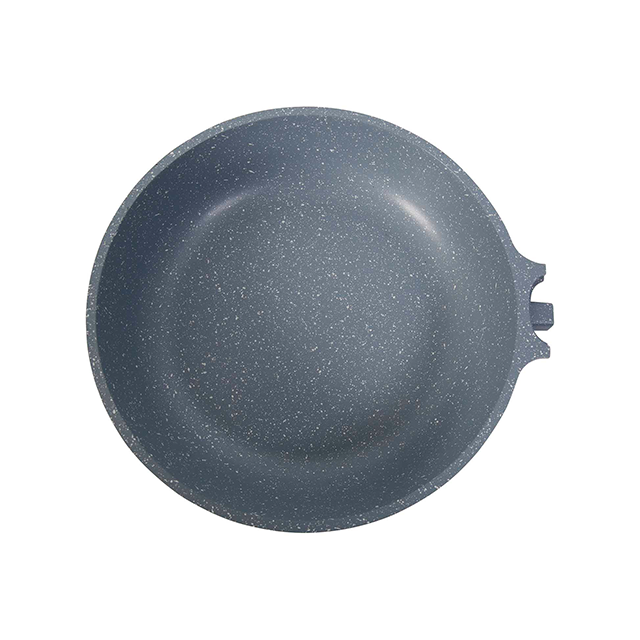
To combat the destructive forces of kitchen thermodynamics, material engineers developed a highly sophisticated, sandwich-like structural system. Instead of relying on a single chemical formula to handle adhesion, flexibility, and slickness simultaneously, a premium three layer non stick coating divides these critical responsibilities across specialized tiers. When properly applied, this entire matrix typically measures between 35 to 45 microns in total dry film thickness.
The primer is the foundational base and arguably the most critical component for surviving sudden temperature drops. This tier is formulated with specialized high-performance binders, such as polyamide-imide or polyethersulfone. These industrial polymers are selected for their exceptional adhesive properties and heat stability.
The primer serves two vital functions. Specifically, it bonds both chemically and mechanically to the micro-profile of the grit-blasted metal. Furthermore, it acts as an elastic buffer. By matching the thermal expansion characteristics of the steel, the primer can stretch and contract in perfect harmony with the pan, ensuring the bond remains completely intact during violent shifts.
Positioned directly above the anchor is the mid-coat, engineered primarily for structural reinforcement. This transition zone is typically infused with microscopic ceramic, mineral, or hard-metal particles.
Think of the mid-coat as a physical and thermal shock absorber. If a metal spatula scratches the surface, or if extreme stress attempts to initiate a micro-crack, the hard particles within this tier block the fracture from propagating downward into the vulnerable primer. By preventing surface damage from reaching the substrate level, the mid-coat exponentially increases the lifespan of the pan under daily use.
The final, outermost layer is dedicated entirely to culinary performance. Heavily concentrated with fluoropolymers like PTFE, this tier provides the slick, frictionless release properties expected by professional chefs.
Because the lower tiers handle the mechanical stress and adhesion requirements, the top-coat can be optimized purely for chemical resistance and high-heat stability. It is meticulously formulated to withstand direct, repeated contact with cooking temperatures up to 260°C without oxidizing or losing its efficacy.
Recent market analysis highlights a massive shift in how cookware manufacturers approach thermal management. With the rapid global adoption of commercial and residential induction cooktops, thermal cycling has become more aggressive than ever. Induction heating utilizes magnetic fields to heat the pan directly and instantaneously. This causes much faster and more localized metal expansion compared to traditional ambient gas flames.
Consequently, metallurgical engineers and chemical formulators are moving away from rigid surface solutions. The industry trend heavily favors advanced polymer systems that offer high elongation at break. This means the material can stretch significantly without tearing. Commercial kitchens and premium consumer brands are now demanding gradient-elastic formulations specifically designed to survive the harsh, localized hot spots generated by modern 3500-watt induction burners.
Beyond the physical structure of the layers, the chemical carrier and application method are equally vital. Historically, industrial formulations relied heavily on harsh chemical solvents. However, modern engineering has heavily pivoted toward advanced, sustainable alternatives. Today, a premium water based PTFE spray coating stands as the definitive solution for managing heat resistance on challenging metal substrates.
From an empirical standpoint, aqueous dispersions provide distinct structural advantages during the factory curing phase. In these modern formulations, microscopic polymer particles are suspended in water rather than volatile organic compounds. When applied to a heated steel surface, the water evaporates in a highly controlled manner. This allows the polymer particles to pack tightly together before they are baked at extreme temperatures, typically between 380°C and 400°C. The resulting tightly packed matrix is fundamentally more resilient to the stretching and shrinking of the metal beneath it.
Furthermore, the automated spray application method is paramount for survival. Standard roller or dip methods often result in microscopic variations in film thickness. In the context of thermodynamics, uneven thickness is a critical failure point. Thicker areas absorb and retain heat differently than thinner areas, creating localized thermal stress zones. Precision spray technology ensures a perfectly uniform, micron-level thickness across the entire geometry of the skillet. This uniformity guarantees that thermal expansion forces are distributed evenly.
For both manufacturers and informed consumers, choosing between a PTFE-based system and a ceramic sol-gel finish is a critical decision. While both technologies have specific utility, their performance under severe thermal cycling differs dramatically due to inherent mechanical properties.
Ceramic finishes are synthesized using a sol-gel process, creating a silicon dioxide-based matrix. The primary advantage here is extreme hardness and the ability to withstand static heat spikes. However, from a materials science perspective, ceramic is naturally brittle. It possesses a very low elongation at break, meaning it cannot deform without fracturing.
When bonded to an expanding metal like stainless steel, the mismatch in expansion rates generates immense shear stress. Because the brittle ceramic cannot stretch to accommodate the growing steel, it is highly prone to micro-cracking. Over repeated cycles, these microscopic fissures propagate, leading to a total loss of slickness and eventual chipping. Contrast this with the elastic nature of a high-quality polymer matrix, which easily flexes in tandem with the metal.
Performance Metric | Sol-Gel Ceramic Finish | Engineered Three-Tier PTFE System |
|---|---|---|
Inherent Flexibility | Very Low (Naturally Brittle) | High (Elastic Polymer Matrix) |
Thermal Shock Resistance | Moderate (Prone to micro-cracking) | Excellent (Absorbs expansion stress) |
Adhesion to Steel | Good initially, degrades under cycling | Superior (100% Cross-hatch adhesion grade) |
Curing Temperature | 200°C - 250°C | 380°C - 400°C for maximum cross-linking |
The exceptional durability of these advanced systems is not solely dependent on the chemical recipe. It is equally reliant on stringent manufacturing protocols. Because stainless steel is incredibly dense, it requires aggressive mechanical preparation to ensure long-term grip.
The foundational step is surface profiling via grit-blasting. Factory technicians propel abrasive aluminum oxide particles at high velocities against the smooth steel to achieve a specific roughness profile. This process carves out a microscopic topography of peaks and valleys. This mechanical profile drastically increases the surface area, allowing the liquid primer to flow into the valleys and lock into place once baked. Without precise grit-blasting, even the most expensive polymers will peel under heat stress.
Once profiled, the application must be executed with exacting precision using a wet-on-wet technique. The primer is sprayed on, followed immediately by the mid-coat, and then the top-coat, before any layer fully dries. Finally, the pan passes through industrial ovens exceeding 380°C. During this intense baking phase, cross-linking occurs. The intermingled polymer chains fuse together, transforming three wet layers into a single, cohesive, thermal-shock-resistant shield.
When engineering a new cookware line or upgrading commercial kitchen supplies, evaluating the technical specifications of your chosen finish is non-negotiable. Look for formulations that explicitly state they are PFOA and PFOS free, utilize water-based dispersions, and offer a dry film thickness of at least 35 microns. These parameters ensure the product can handle the rigorous demands of thermal cycling.
Even the most robust aerospace-grade engineering can be compromised by repeated exposure to instantaneous temperature differentials. To maximize your investment, adhere to these operational guidelines.
Avoid instantaneous quenching at all costs. The absolute most destructive action you can take is plunging a searing hot pan directly into a sink of cold water. A sudden drop of 150°C or more can exceed the tensile limits of the polymer bond. Always allow pans to cool naturally to room temperature on the stovetop before washing.
Implement gradual preheating. Stainless steel has a lower thermal conductivity compared to pure aluminum, meaning it takes longer to distribute heat. Blasting a cold pan on the highest heat setting forces the bottom to expand rapidly while the sides remain cool, creating internal structural tension. Preheat gradually on low-to-medium settings.
Modern thermodynamics no longer dictate the inevitable ruin of your favorite kitchen tools. The intelligent combination of a highly elastic primer, a structurally reinforced mid-coat, and a chemically resistant top-layer allows stainless steel to overcome its natural expansion challenges. By utilizing advanced aqueous spray technologies, manufacturers can now produce incredibly uniform, densely packed barriers that stretch and breathe with the metal.
While stainless steel remains one of the most difficult substrates to protect, precision engineering has solved the puzzle. Ready to upgrade your manufacturing line or commercial kitchen? Evaluate your specific substrate and thermal requirements, and explore the high-performance, PFOA-free solutions at https://www.fldcoating.com to find the exact multi-tier formulation for your next project.
No, standard culinary temperatures do not alter the metallurgical structure or permanently weaken the steel itself. The melting point of this metal is well above 1,300°C. However, rapid temperature changes can easily destroy standard surface finishes if they are not engineered with a flexible polymer matrix designed to stretch with the metal.
Yes. Modern engineered systems, particularly those utilizing water-based formulations, are strictly regulated and rigorously tested for consumer safety. They are manufactured entirely without PFOA or PFOS and remain chemically inert once fully cured in the factory at temperatures around 400°C. They are perfectly safe for daily use provided they are kept within recommended temperature thresholds, typically up to 260°C.
Peeling, technically known as delamination, is primarily the result of thermal shock, aggressive metal utensils, or inadequate factory preparation. When the metal expands under heat, a cheap single-layer finish cannot stretch to accommodate the movement. The resulting shear stress breaks the bond, causing it to flake away from the smooth steel.
Aqueous water-based systems are significantly more environmentally sustainable and emit drastically fewer volatile organic compounds during manufacturing. From a performance perspective, when applied via automated spray technology, water-based formulas allow the polymer particles to pack much denser during the curing phase. This creates a highly uniform matrix that fundamentally resists thermal cracking.
For professional-grade stainless steel cookware, a high-quality three-tier system should have a total dry film thickness between 35 and 45 microns. This specific thickness provides the perfect balance. It is thick enough to offer excellent wear resistance and thermal shock absorption, yet thin enough to prevent heat retention issues that could lead to blistering.
Yes, they absolutely can. Induction cooktops use magnetic fields to generate heat directly inside the steel almost instantaneously. This rapid, localized heating forces the bottom of the pan to expand much faster than the sides. To prevent failure on induction hobs, the applied surface must feature an advanced, highly elastic primer capable of absorbing this aggressive mechanical stress.

Which Spray Parameters Matter for Sprinkled Non Stick Coating?

How Does Double Layer Coating Improve Primer and Topcoat Bonding?

How Can Frying Pan Coating Improve Coverage Around Curved Edges?

Nano Ceramic Coating Process for Electric Iron Soleplates

How Can Three Layer Coating Handle Thermal Cycling on Stainless Steel?

How Can Rice Cooker Inner Pot Coating Improve Rice Release?

How Can Aluminum Cookware Avoid Distortion During Coating Curing?

How Should Curing Temperature Be Set for Nano Ceramic Coating?

Which Formulation Factors Affect Non Stick Coating Scratch Resistance?

How Should Air Fryer Coating Be Tested for Oil and Cleaning Resistance?

