


Views: 0 Author: Site Editor Publish Time: 2026-07-24 Origin: Site


Consumer demand for convenience makes non-stick surfaces a baseline expectation in modern manufacturing. The engineering behind these surfaces faces unprecedented scrutiny due to evolving chemical regulations and higher performance standards. Original Equipment Manufacturers and product designers must balance thermal stability, abrasion resistance, and strict regulatory compliance without inflating manufacturing complexities or risking premature product failure. Selecting the correct formulation requires moving beyond generic consumer labels and understanding the underlying polymer science. We evaluate the technical specifications, application methods, and performance trade-offs of modern non-stick chemistries. Engineering and procurement teams will learn how to specify the exact Non-Stick Coating Applications required for high-wear environments, ensuring durability and compliance across product lines.
Establishing baseline success metrics is the mandatory first step before evaluating chemical formulations. An appliance's operational environment dictates the required polymer structure. Engineers must define the maximum continuous operating temperature, the frequency of thermal cycling, and the expected mechanical wear. A coating designed for a low-temperature dough mixer will fail rapidly if applied to a high-heat searing grill. Accurately mapping the operational environment prevents over-engineering and ensures the chosen chemistry aligns with real-world usage patterns. You must document the exact thermal loads the substrate will experience during standard operation and extreme misuse scenarios.
Thermal dynamics play a massive role in coating performance. Evaluating continuous operating temperatures versus peak temperature spikes determines polymer survival. Some polymers handle 200°C continuously but degrade quickly if subjected to 260°C spikes during a preheat cycle. Additionally, engineers must assess how the coating impacts thermal conductivity from the heating element to the food. The coating layer acts as a thermal insulator. Balancing heat transfer rates allows proper browning through the Maillard reaction without compromising the release integrity of the non-stick surface. If the coating insulates too much, the appliance fails to cook efficiently. We measure thermal degradation using specific testing protocols.
Mechanical wear destroys non-stick properties faster than thermal degradation. Defining wear metrics based on expected consumer behavior provides realistic durability targets. Taber abrasion testing provides baseline data, but real-world conditions involve abrasive cleaning pads, metal utensils, and nesting during storage. A robust appliance coating must withstand these daily abuses. Hardness ratings and scratch resistance tests help determine if a multi-layer system is necessary to protect the underlying substrate from gouging. We look at pencil hardness and cross-hatch adhesion to verify mechanical integrity.
Kitchen environments expose coatings to aggressive chemical agents. Analyzing coating resilience against polymerized cooking oils, commercial aerosol cooking sprays, and harsh dishwasher detergents prevents premature failure. Aerosol sprays often contain emulsifiers that carbonize at low temperatures, creating a sticky residue that binds to the coating and ruins its release properties. High-pH dishwasher detergents attack certain polymer matrices, leading to dulling and degradation. Formulations must undergo rigorous chemical exposure testing.
Navigating the complex landscape of food safety regulations is non-negotiable. Manufacturers must comply with FDA food contact notifications and European Food Safety Authority guidelines. Furthermore, the global phase-out of specific per- and polyfluoroalkyl substances (PFAS) forces rapid formulation changes. Staying ahead of these regulatory shifts ensures products remain viable in international markets. Compliance testing must integrate into the earliest phases of product development to avoid costly redesigns later. You must secure material safety data sheets and compliance certificates for every layer of the coating system.
Air fryers present a unique challenge due to convective heat and high-fat environments. The rapid circulation of hot air combined with splattering oils creates a harsh environment for any surface. Evaluating air fryer coating choices requires focusing on formulations that prevent polymerized grease buildup while withstanding frequent, aggressive dishwasher cycles. Multi-layer systems with high cross-linking density maintain release properties after hundreds of high-temperature cooking sessions. The primer layer must bond aggressively to the perforated metal baskets to prevent peeling around the stamped holes.
Fabric care appliances demand a delicate balance of physical properties. An effective iron coating provides exceptional glide, meaning a very low coefficient of friction, while maintaining high scratch resistance against zippers, buttons, and snaps. Specialized formulations are required inside steam generation chambers. These internal coatings prevent scale buildup from hard water and resist corrosion, ensuring the steam vents remain clear and functional over the lifespan of the appliance. The application process often involves precise masking to keep the coating out of threaded assembly holes.
These appliances involve direct, high-temperature contact and the release of challenging substances like high-sugar or high-protein batters. Managing these sticky residues requires coatings with exceptional high-temperature release characteristics. Ensuring even coating distribution on complex, deep-ribbed topographies is a significant manufacturing challenge. Liquid spray applications must be carefully calibrated to prevent pooling in the valleys and thinning on the peaks of the grill plates. Electrostatic spray guns help wrap the coating around sharp corners for uniform coverage.
Multi-cookers subject coatings to prolonged boiling, acidic ingredients, and intense starch adhesion. Starch is notoriously difficult to release once it dries or bakes onto a surface. Mitigating these effects requires evaluating multi-layer systems featuring a robust primer, a durable mid-coat, and a highly specialized top-coat. This layered approach provides the necessary barrier protection for extended submersion durability, preventing moisture from penetrating the coating and causing delamination from the aluminum substrate. The top-coat often incorporates specific fluoropolymers designed for starch release.
Beyond primary appliances, high-wear kitchen tools such as food processor blades, mixer attachments, and commercial baking pans rely heavily on specialized surface treatments. Preventing food buildup on these complex geometries minimizes motor strain and optimizes process efficiency. A dough hook that sheds sticky mixtures easily reduces the load on the mixer's internal gears. Selecting the right formulation for these accessories involves balancing impact resistance with food-safe release properties. Nylon and silicone utensils also require compatible coatings that do not degrade the underlying plastic.
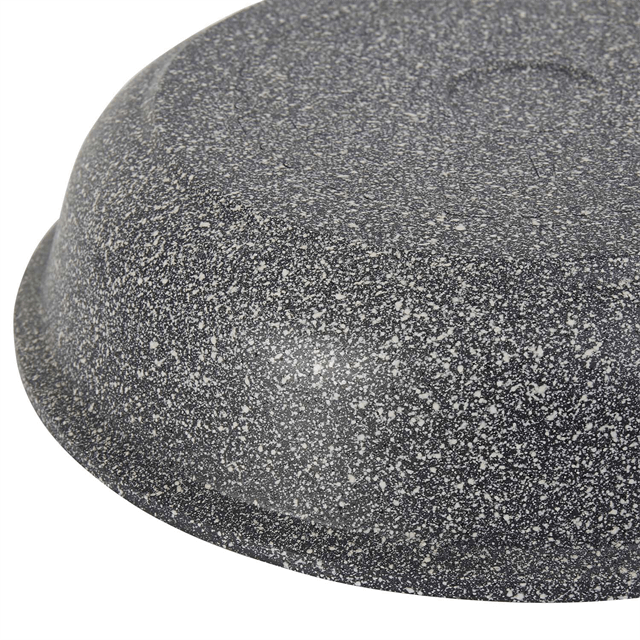
Fluoropolymers offer unmatched release properties and an incredibly low coefficient of friction. They prevent food from sticking even without preheated fats, making them highly desirable for consumer convenience. However, they have distinct limitations. Their maximum continuous operating temperatures are typically capped around 260°C. Exceeding this limit causes degradation. They are vulnerable to carbonized oil buildup if consumers use incorrect cooking sprays. Increasing regulatory pressure regarding manufacturing byproducts prompts many manufacturers to seek alternatives. We apply these in three-coat systems for maximum durability.
Sol-Gel ceramic coatings provide high hardness, often reaching a pencil hardness of 7H to 9H, and excellent thermal stability up to 400°C. This high heat tolerance enables superior food browning and searing capabilities, making them ideal for grills and roasters. The primary limitation is the faster degradation of release properties over time compared to traditional fluoropolymers. Ceramics are more brittle under mechanical stress and impact, meaning they can chip if a pan is dropped or struck with heavy utensils. Application requires precise humidity control in the spray booth.
Silicone glazes and resins are cost-effective solutions excellent for high-sugar release. They are frequently used in commercial bakeware and specific food prep accessories. While they excel in releasing baked goods, their limitations include lower abrasion resistance. They are generally unsuitable for high-friction appliance components or surfaces subjected to aggressive scrubbing. Silicone is best reserved for applications where chemical release is prioritized over mechanical durability. Curing times for silicone are often shorter, increasing production line throughput.
| Coating Chemistry | Max Continuous Temp | Abrasion Resistance | Primary Application |
|---|---|---|---|
| PTFE (Fluoropolymer) | 260°C (500°F) | Moderate to High (Multi-coat) | Rice cookers, skillets, low-heat baking |
| Sol-Gel Ceramic | 400°C (750°F) | High (Brittle under impact) | Indoor grills, panini presses, roasters |
| Silicone Resin | 230°C (450°F) | Low | High-sugar bakeware, specific utensils |
Comparing spray coating for complex geometries against coil coating for flat-stamped components reveals significant manufacturing differences. Conventional and electrostatic spray systems require extensive masking, precise fluid delivery, and regular maintenance to prevent clogging. Coil coating applies the polymer to flat metal sheets before stamping, offering massive throughput advantages. However, coil-coated metals suffer micro-cracking during deep-draw stamping processes, compromising the non-stick barrier. You must evaluate the geometry of the final part before selecting the application method.
The required curing temperature of the coating dictates the choice of substrate. High-performance fluoropolymers often require curing temperatures exceeding 400°C to achieve proper cross-linking. Exposing certain aluminum alloys to these temperatures causes annealing, softening the metal and ruining its structural integrity. Engineers must select alloys that maintain their yield strength after passing through the curing oven. Hard-anodized aluminum provides an excellent base for coatings but adds significant processing time and chemical handling requirements.
Balancing the upfront cost of a premium three-coat system against the long-term savings of reduced consumer returns requires careful analysis. A single-coat system saves money on the production line but fails rapidly in the field, leading to brand damage and high warranty replacement rates. Investing in a robust primer and a high-build top-coat increases the per-unit manufacturing cost but drastically extends the product lifecycle. We track field failure data to justify the specification of higher-grade polymer matrices.
Coating separation due to thermal shock, poor surface roughening, or inadequate primer application is a severe failure mode. If the substrate is not properly grit-blasted, the mechanical bond fails. Mitigating this risk requires implementing strict surface profile monitoring. Automated spray lines ensure consistent mil thickness, preventing areas of under-application that are prone to blistering. Regular cross-hatch adhesion testing during production catches delamination issues before products ship. We mandate a specific Ra (roughness average) profile for all incoming metal substrates.
Rapid degradation caused by sudden temperature transitions is a common consumer care reality. Exposing a hot appliance surface to cold water causes the metal substrate and the coating to contract at different rates, leading to micro-fractures. Incorporating thermal shock testing standards during the prototyping phase is mandatory. Engineers must select coatings with high elastic recovery that absorb these rapid dimensional changes without cracking or losing adhesion. We test this by heating panels to 260°C and immediately plunging them into ice water.
The sudden obsolescence of a specified coating due to regional chemical bans poses a massive supply chain risk. Relying on a single formulation leaves production lines vulnerable to regulatory changes. Mitigation involves dual-sourcing coating formulations and pre-qualifying next-generation PFAS-free alternatives during the prototyping phase. Maintaining approved alternative chemistries ensures production pivots immediately if a primary material becomes restricted. You must audit your chemical suppliers annually to verify their compliance roadmaps.
Over-application leads to mud-cracking during the curing process, while under-application leads to premature wear and poor release. Maintaining exact thickness parameters dictates field performance. Utilizing dry film thickness gauges and integrating them into standard operating procedures prevents these defects. Automated optical inspection systems monitor wet film thickness in real-time, allowing operators to adjust spray parameters before parts enter the curing oven. We calibrate our spray guns twice per shift to maintain tight tolerance bands.
The optimal non-stick surface is a highly specific engineering choice dictated by the appliance's maximum thermal load, mechanical wear expectations, and target market regulations. Default to Sol-Gel ceramics for high-heat, direct-contact appliances where culinary browning is a primary feature. Utilize advanced, compliant fluoropolymers for complex geometries requiring maximum release.
A: Sol-Gel ceramic coatings are the best choice for high-temperature appliances. They offer excellent thermal stability, withstanding continuous temperatures up to 400°C. This makes them ideal for indoor grills, panini presses, and searing surfaces where traditional polymers would degrade rapidly.
A: A high-quality multi-layer coating in an air fryer typically lasts between two to three years under daily use. Longevity depends heavily on consumer habits, such as avoiding aerosol cooking sprays and utilizing non-abrasive cleaning methods.
A: Yes, genuine Sol-Gel ceramic coatings are manufactured without the use of per- and polyfluoroalkyl substances. They rely on silicon-based chemistry rather than carbon-fluorine bonds, making them fully compliant with emerging global PFAS restrictions.
A: Peeling and blistering result from inadequate substrate preparation, such as insufficient grit blasting, or improper curing temperatures during manufacturing. Severe thermal shock, like plunging a hot pan into cold water, also breaks the mechanical bond.
A: Manufacturers use automated electrostatic or conventional liquid spray systems to coat complex geometries. The parts rotate on spindles while robotic arms apply precise layers of primer, mid-coat, and top-coat to ensure uniform thickness across all surfaces.
A: Substrate preparation is the foundation of coating longevity. Proper degreasing and grit blasting create a specific surface roughness profile. This profile provides the necessary anchor pattern for the primer to achieve a strong mechanical bond, preventing future delamination.

Which Spray Parameters Matter for Sprinkled Non Stick Coating?

How Does Double Layer Coating Improve Primer and Topcoat Bonding?

How Can Frying Pan Coating Improve Coverage Around Curved Edges?

Nano Ceramic Coating Process for Electric Iron Soleplates

How Can Three Layer Coating Handle Thermal Cycling on Stainless Steel?

How Can Rice Cooker Inner Pot Coating Improve Rice Release?

How Can Aluminum Cookware Avoid Distortion During Coating Curing?

How Should Curing Temperature Be Set for Nano Ceramic Coating?

Which Formulation Factors Affect Non Stick Coating Scratch Resistance?

How Should Air Fryer Coating Be Tested for Oil and Cleaning Resistance?

