


Views: 0 Author: Site Editor Publish Time: 2026-10-23 Origin: Site


Have you ever dealt with a commercial kitchen batch where the pans failed within months? A common nightmare for procurement teams and home chefs alike is investing in cookware that loses its slick surface after just a short period of heavy rotation. When the finish degrades prematurely, eggs cling relentlessly to the center. Cleaning becomes a labor-intensive chore. Ultimately, the product ends up in a landfill. This widespread issue highlights a critical reality in cookware manufacturing: surface quality varies wildly across the market.
The true measure of a high-quality skillet lies not in glossy marketing brochures but in scientific testing. Specifically, engineers look at standardized abrasion cycles. To guarantee a durable non stick coating, manufacturers rely on rigorous mechanical friction testing in controlled laboratory environments. This breakdown will explain exactly how these evaluations work and the underlying chemistry of wear resistance. Grasping the mechanics of abrasion cycles is the fundamental key to assessing true product longevity.
Key Takeaways
The foundation of any high-performance cookware surface begins at the microscopic level. The most prevalent material utilized is Polytetrafluoroethylene, commonly known as PTFE. At a molecular scale, PTFE consists of a carbon backbone heavily shielded by fluorine atoms. Because the carbon-fluorine bond is one of the strongest in organic chemistry, the material remains highly unreactive and extremely hydrophobic. This dense structure prevents water, oils, and food proteins from forming strong bonds with the metal. The result is the characteristic low-friction release.
Alternatively, ceramic options utilize sol-gel technology derived from silicon dioxide to create a slick inorganic network. Regardless of the chemical base, the ultimate engineering goal is to maintain this molecular integrity under thermal stress and mechanical friction. If the molecular structure degrades, the slick properties diminish rapidly.
A surface that seamlessly repels food is functionally useless if it easily peels away from the pan. Adhesion serves as the critical structural counterpart to slickness. Securing a fluoropolymer matrix to a smooth metal substrate like aluminum requires complex engineering.
Manufacturers achieve this robust bond through a meticulous preparation process. First, the bare metal substrate is roughened through sandblasting to create microscopic jagged peaks and valleys. This expands the surface area significantly. Next, a specialized primer layer formulated with binding resins is applied. This primer mechanically interlocks with the rough metal while simultaneously fusing chemically with the top-coat. This dual-bonding approach ensures the finish remains firmly anchored to prevent catastrophic delamination under intense physical stress.
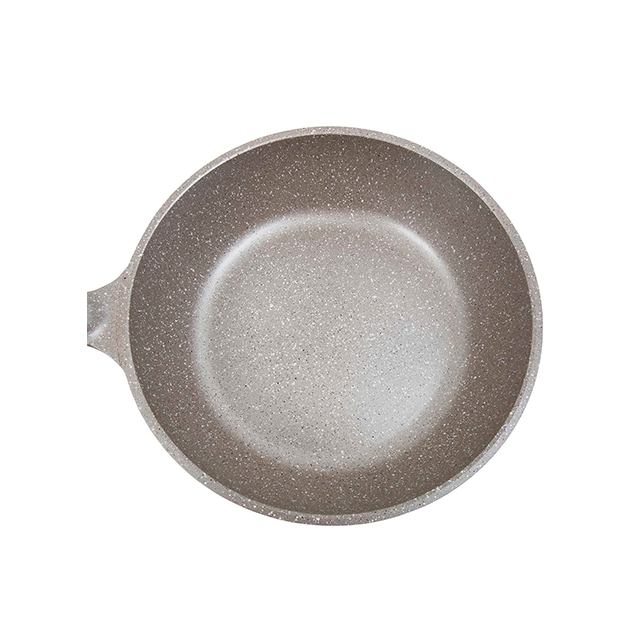
In the context of quality control, an abrasion cycle acts as a standardized metric used to evaluate surface wear. Defined simply, one cycle represents a single complete back-and-forth motion of a weighted abrasive pad across the cookware.
Instead of relying on subjective human testing, laboratories deploy automated machinery to execute these strokes. The equipment applies a constant downward force onto an abrasive material, dragging it across the pan at a consistent speed. By counting the exact number of strokes the surface can endure before failing, engineers obtain hard data regarding mechanical strength.
The primary purpose of laboratory testing is to compress years of real-world kitchen abuse into a matter of days. In a bustling commercial kitchen, cookware faces relentless daily mechanical stress. Imagine the scrape of a metal spatula flipping a burger or the vigorous scrubbing of a rigid cleaning sponge.
By utilizing specific abrasive pads and heavy weights, the controlled environment accelerates this wear. A few thousand automated cycles in a lab can accurately replicate the friction a skillet would experience over several years of standard cooking. This simulation guarantees the product will not prematurely degrade when subjected to the daily rigors of a modern culinary environment.
Quality control laboratories utilize specialized reciprocating abrasion testers to conduct these evaluations. The testing apparatus features a motorized mechanical arm designed to move in a precise linear trajectory.
To mimic the downward pressure applied by a human hand during vigorous scrubbing, standardized weights are attached to the testing arm. Depending on the strictness of the protocol, the applied load typically ranges from 1.5 kilograms to 3.0 kilograms. The machine is calibrated to maintain a consistent speed of around 40 cycles per minute. This ensures every stroke exerts the exact same amount of kinetic friction on the test subject.
The abrasive medium used in the test is strictly regulated to ensure consistency across different manufacturing batches. Laboratories commonly deploy standardized scouring pads like the 3M Scotch-Brite 7447. This provides a uniform level of abrasiveness.
During the procedure, the pan is rarely tested dry. To better replicate authentic dishwashing conditions, both the abrasive pad and the coating surface are submerged in a specific mixture of water and standardized detergent. The mechanical arm then grinds the pad across the wet surface. This wet-abrasion method acts as a mild lubricant while mimicking chemical exposure. It provides a highly accurate assessment of how the surface will hold up against aggressive daily cleaning routines.
The test runs continuously until the surface reaches a defined point of failure. Crucially, failure is not determined by a casual glance. It is measured using strict visual and microscopic criteria.
Typically, a pan fails the test when the scrubbing pad wears through the layers enough to expose the underlying bare metal substrate. Inspectors look for a specific percentage of metal exposure, often when 5 percent of the testing path reveals the aluminum base. Microscopic evaluations may also be conducted to assess micro-scratching before total failure occurs. Once this threshold is breached, the machine stops and the final count is recorded.
Looking at the broader cookware manufacturing sector, there is a definitive shift in how brands communicate quality. Historically, the industry relied heavily on subjective marketing buzzwords. Today, B2B procurement teams demand quantifiable metrics. Driven by global sustainability goals and stricter regulatory frameworks, manufacturers are heavily investing in advanced polymer matrices. The objective is to double the lifecycle of commercial pans to directly reduce landfill waste. Buyers are no longer just purchasing a pan. They are investing in verified longevity.
The number of cycles a pan can survive directly dictates its market positioning. For baseline domestic cookware, a standard finish is generally expected to withstand between 3,000 to 5,000 cycles. This provides adequate durability for occasional home cooking.
In practice, an abrasion resistant cookware coating designed for intensive commercial use must meet much higher thresholds. Premium formulations are engineered to endure anywhere from 15,000 to over 50,000 cycles. These high-cycle surfaces utilize advanced binders and reinforcing mineral particles to resist severe mechanical degradation.
To simplify the selection process, engineers evaluate specific application parameters. Below is a practical guide mapping application scenarios to the appropriate technical specifications.
| Application Scenarios | Target Abrasion Cycles | Structure Recommendation | Key Engineering Parameters |
|---|---|---|---|
| Light Domestic Bakeware | 3,000 - 5,000 | Single Layer PTFE | Curing at 380°C, 10-15μm dry film thickness |
| Specialty Griddles | 8,000 - 15,000 | Reinforced Single/Dual Layer | Titanium enhanced, 20-25μm dry film thickness |
| Intensive Commercial Kitchens | 15,000 - 50,000+ | Premium Multi-Layer PTFE | Mineral reinforced mid-coat, 35-40μm dry film thickness |
A common misconception within the culinary world is that only thick multi-layer systems can provide long-lasting wear resistance. Recent advancements in polymer science have entirely revolutionized single-layer applications.
Modern chemical formulations incorporate robust binding resins mixed with ultra-hard reinforcing particles like silicon carbide or synthetic diamond dust. These microscopic hard particles act as a structural shield to absorb mechanical friction. As a result, a well-engineered durable single layer kitchenware coating can exhibit exceptional abrasion resistance. This streamlined approach offers an optimal balance between manufacturing cost-efficiency and highly reliable end-user performance. It is particularly suitable for high-volume bakeware production.
While single layers are highly efficient, multi-layer systems are deployed when maximum durability and supreme release properties are required simultaneously. In a premium three-coat system, each layer is formulated for a distinct scientific purpose.
The primer focuses entirely on adhesion to prevent delamination. Following this, the mid-coat acts as the structural backbone. It is heavily loaded with hard reinforcing minerals to provide maximum scratch resistance. Finally, the top-coat contains the highest concentration of PTFE materials to deliver the ultimate low-friction surface. By separating these functions, multi-layer systems achieve extreme cycle counts, though they inherently require more complex manufacturing processes.
Abrasion resistance represents only one facet of overall durability. The finish must also remain firmly attached to the pan under various stresses. The cross-hatch adhesion test evaluates this critical bond.
Technicians use a specialized cutting tool to slice a precise grid pattern directly through the layers down to the metal substrate. A highly aggressive pressure-sensitive tape is then firmly applied over the grid and rapidly ripped off. The grid is inspected to see if any squares flaked off with the tape. A strong finish will show zero delamination.
Cookware is frequently exposed to harsh salty environments which can penetrate microscopic pores and degrade integrity over time. To test chemical resilience, pans are subjected to intense saltwater boiling tests.
A solution containing 5 percent sodium chloride is boiled continuously inside the pan for extended periods, sometimes up to 48 hours. Afterward, technicians meticulously inspect the surface for signs of osmotic blistering or underlying metal rust. Passing this rigorous evaluation ensures the product functions as an impermeable barrier against harsh cooking ingredients.
Kitchenware regularly experiences rapid temperature fluctuations, such as a scorching hot pan being tossed straight into a sink of cold water. These sudden changes cause the metal and the surface to expand and contract at different rates. This can lead to catastrophic failure.
During thermal shock testing, the pan is heated to a high temperature of around 260°C in an industrial oven. It is then immediately plunged into ambient water. This extreme stress cycle is repeated multiple times. A premium finish will maintain its structural integrity without warping or cracking.
The theoretical durability of a chemical formulation can only be fully realized through flawless manufacturing execution. The application environment plays an absolutely critical role.
High-quality finishes are applied in strictly climate-controlled dust-free cleanrooms. Even a single microscopic dust particle can create a weak point in the film. Manufacturers utilize automated electrostatic spray guns mounted on robotic arms to apply the liquid dispersion. This automation guarantees a perfectly uniform Dry Film Thickness. If the layer is applied too thin, it will fail laboratory tests rapidly. If it is too thick, it risks mud-cracking during use.
The final step in the manufacturing process is curing. After the liquid is sprayed onto the pan, the cookware is passed through massive industrial ovens.
For PTFE-based systems, the curing temperature often exceeds 400°C. At these extreme temperatures, the individual solid polymer particles melt and fuse together. They transition from a dispersed liquid into a solid continuous film. Precise temperature control is mandatory. Under-curing results in a soft vulnerable surface that fails abrasion tests instantly. Over-curing can burn the polymers and permanently destroy the release properties.
Even the most rigorously tested surfaces require proper maintenance to maximize their operational lifespan. While laboratory tests prove that premium pans can handle tens of thousands of abrasive cycles, end-users should avoid artificially accelerating this wear at home.
Consumers are strongly advised against using steel wool or highly abrasive metallic sponges. Daily cleaning should be performed using soft sponges combined with warm soapy water. Because the surface is inherently hydrophobic, stubborn burnt-on food can usually be lifted by simply soaking the pan in warm water for ten minutes. This entirely eliminates the need for aggressive scrubbing.
The selection of cooking utensils directly impacts longevity. Metal utensils like carving knives or sharp steel spatulas create concentrated point-load pressure. This pressure can easily exceed the mechanical limits of the top-coat and carve deep scratches into the surface.
To protect structural integrity, users should exclusively utilize utensils crafted from softer non-abrasive materials. Heat-resistant silicone and traditional wooden spoons are highly recommended. These materials glide smoothly without causing micro-abrasions.
Verifying a resilient surface is not a matter of guesswork. It is a rigorous scientific process heavily reliant on mechanical abrasion cycle testing. By simulating years of harsh kitchen friction in a controlled laboratory setting, manufacturers can objectively guarantee the lifespan of their products.
Whether you are selecting a heavy-duty multi-layer system for a commercial restaurant or a streamlined single-layer solution for home bakeware, looking for products that have passed extensive friction tests guarantees a significantly better return on investment. B2B buyers and consumers alike should prioritize transparency in testing standards when sourcing cookware. Visit FLD Coating today to explore our rigorously tested, high-performance solutions designed to withstand the toughest culinary environments.
An abrasion cycle is a standardized laboratory test where a weighted abrasive pad is mechanically rubbed back and forth across the pan. This automated process simulates years of vigorous cleaning and cooking friction to objectively measure lifespan.
While basic entry-level pans may survive 3,000 to 5,000 cycles, a high-quality commercial finish can withstand anywhere from 15,000 to over 50,000 cycles before the underlying bare metal is exposed.
Yes. Modern chemical engineering allows a single-layer application to be reinforced with strong binding resins and ultra-hard particles like titanium. This offers excellent wear resistance for specific applications, especially when balancing cost-efficiency with high performance.
Deep scratches that penetrate down to the bare metal can compromise the entire pan. This leads to flaking, rusting, and a total loss of release properties. High abrasion resistance prevents everyday utensils from causing those fatal deep scratches.
While you cannot replicate exact laboratory cycles without specialized machinery, you can monitor durability practically. Observe how easily delicate foods like eggs release over time. Regularly check for visible surface scratches or dull spots after standard cleaning with a soft sponge.
Consistently overheating a pan beyond 260°C breaks down the polymer bonds at a molecular level. This thermal degradation drastically reduces the abrasion resistance, making the surface brittle and highly susceptible to flaking during normal washing.
A pan should be retired immediately when you observe visible peeling, deep scratches exposing the bare aluminum substrate, or when the surface becomes persistently sticky despite thorough cleaning. Continuing to use a compromised pan impacts food quality and operational efficiency.

What Hardness and Wear Resistance Does Demolding Coating Need?

How Can Cake Pan Coating Reduce Buildup Around Edges?

How Can Non Stick Coating Improve Corrosion Resistance on Aluminum Cookware?

How Is Durable Non Stick Coating Verified Through Abrasion Cycles?

How Do You Control Film Thickness in Water Based Fluorine-Free Coating?

Which Spray Parameters Matter for Sprinkled Non Stick Coating?

How Does Double Layer Coating Improve Primer and Topcoat Bonding?

How Can Frying Pan Coating Improve Coverage Around Curved Edges?

Nano Ceramic Coating Process for Electric Iron Soleplates

How Can Three Layer Coating Handle Thermal Cycling on Stainless Steel?

